
System Design Insights
Deep dives, tutorials, and practical guides to level up your architecture skills.

Database Schema Design Interview Questions (With Answers)

Best System Design Platforms to Practice in 2026 (Compared)
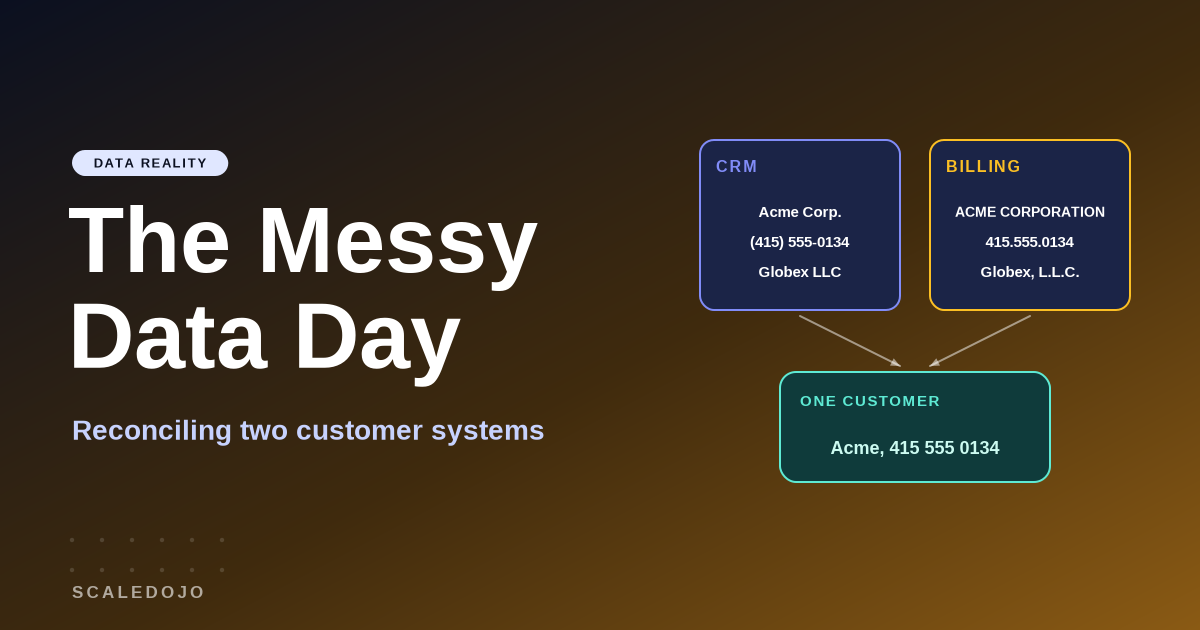
The Messy Data Day: Reconciling Two Customer Systems
How to reconcile two customer systems: profile, normalize, match in layers, review the unsure pairs and load safely, with a matcher to try.
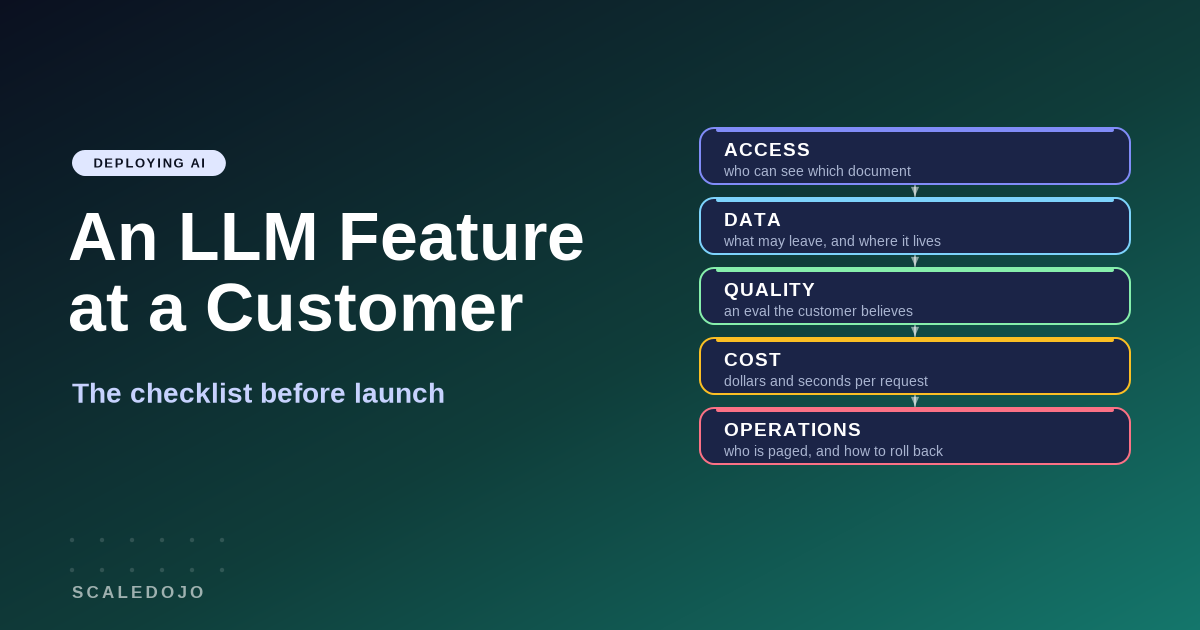
Deploying an LLM Feature at a Customer: The Checklist
Five gates to clear before an LLM feature goes live at a customer: access, data, quality, cost and operations, with a launch check.
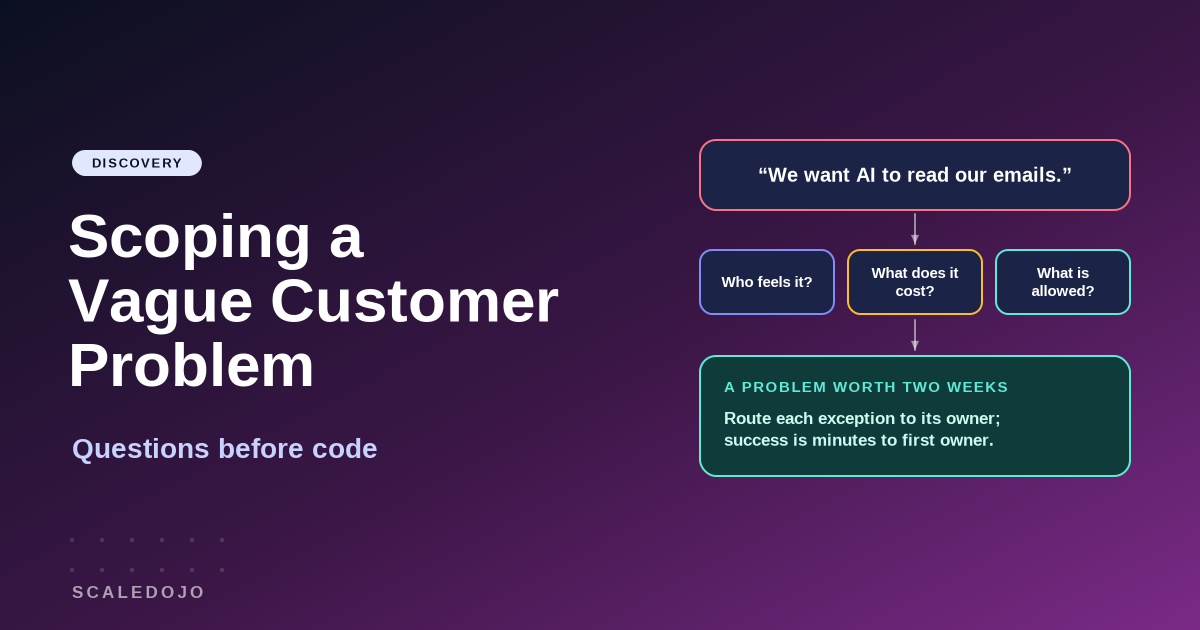
Scoping a Vague Customer Problem: Questions Before Code
How a forward deployed engineer turns a vague customer request into a problem worth a two-week pilot, with a practice call you can try.
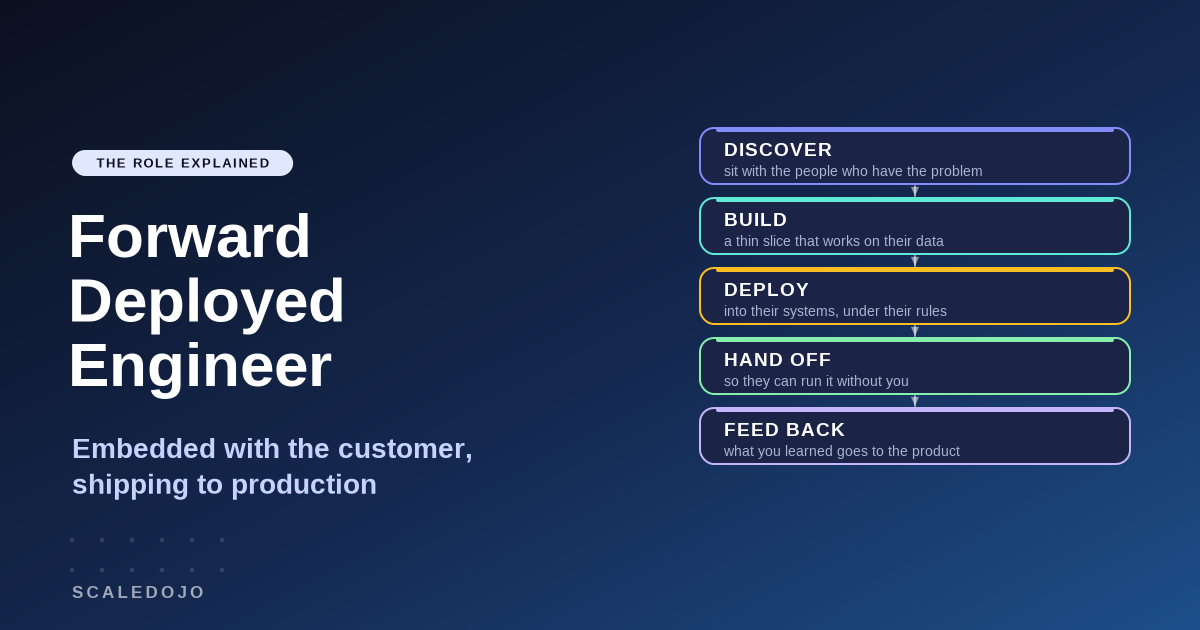
What Is a Forward Deployed Engineer? The Role Explained
What a forward deployed engineer does, how the role differs from software, solutions and consulting jobs, and what employers publish about it.

Why Choose ScaleDojo? A System Design Practice Platform with 10 Hands-On Features

Forward Deployed Engineer Interview Prep: Decomposition and System Design Guide
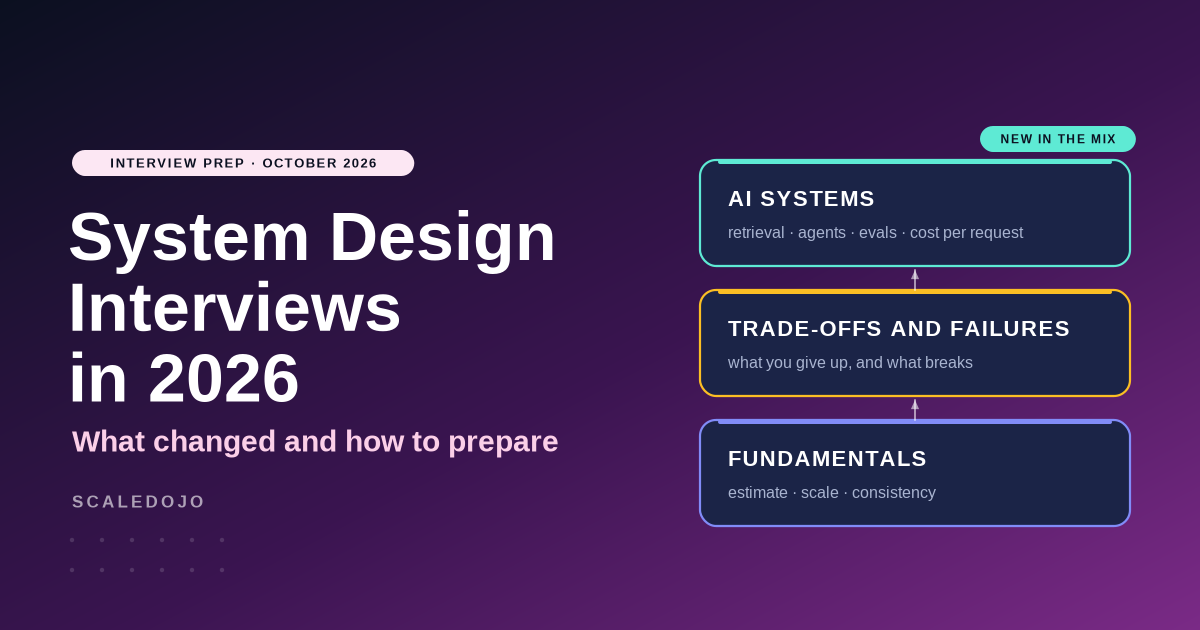
System Design Interviews in 2026: What Changed and How to Prepare
What has changed in system design interviews in 2026: AI-assisted rounds, AI-system prompts and deeper trade-offs, mapped to a practice plan.
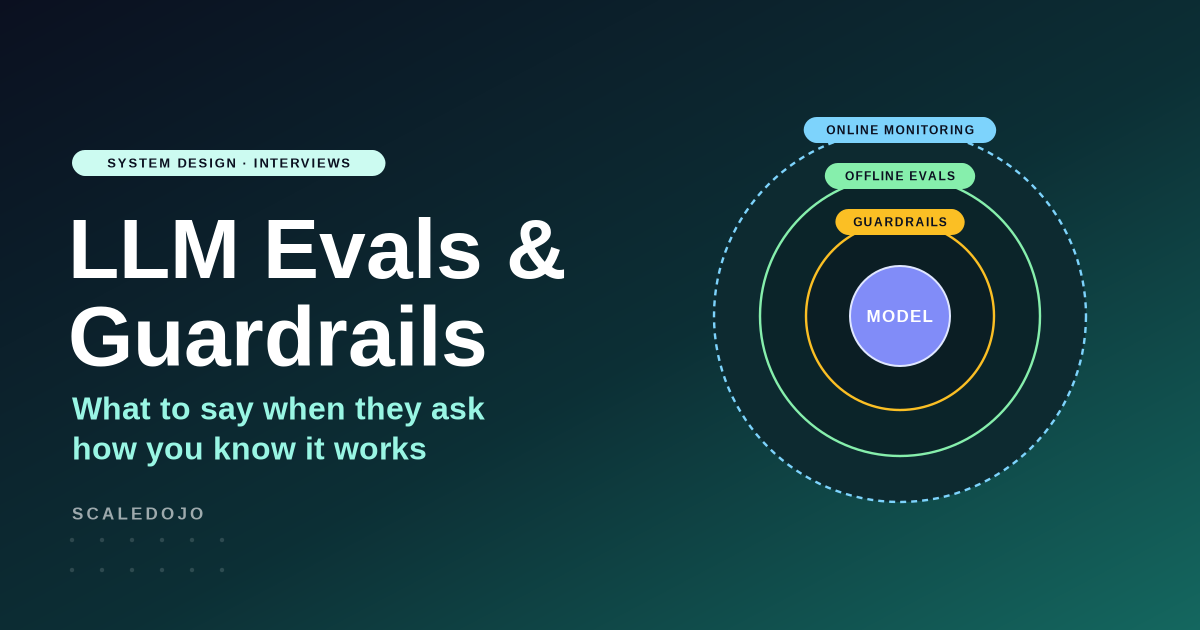
LLM Evals & Guardrails in System Design Interviews: What to Say
Most candidates skip the evaluation and safety layer of an AI design. Here is a concrete checklist, and what to say about it in 90 seconds.
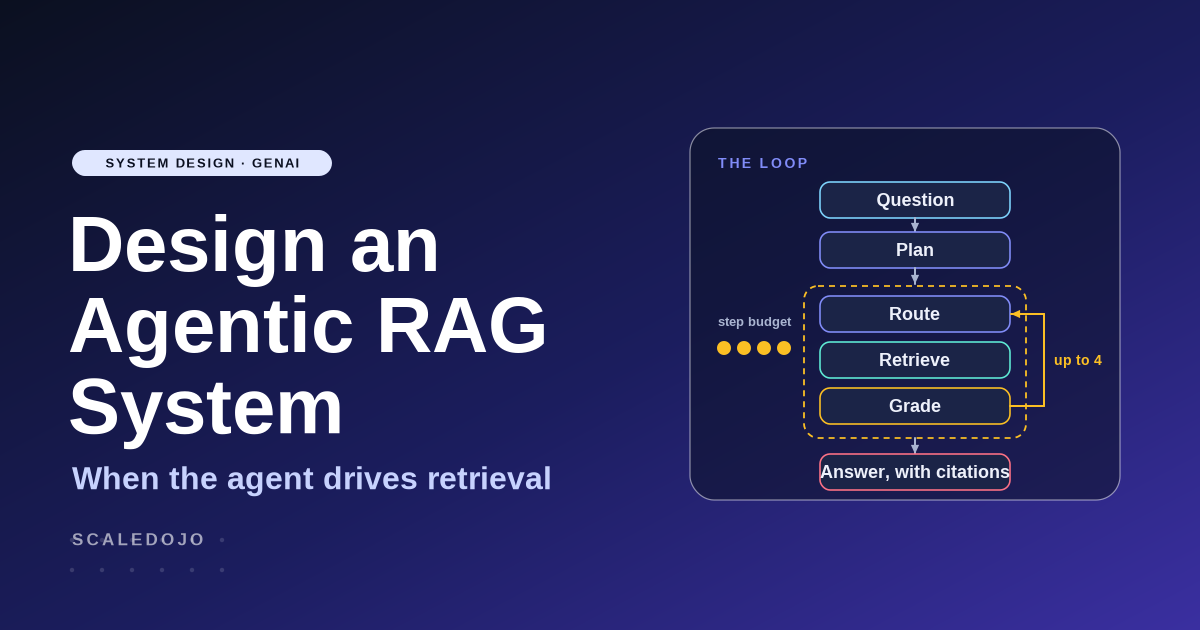
Design an Agentic RAG System: When the Agent Drives Retrieval
How to design an agentic RAG system in an interview: query planning, tool routing, failure modes and a latency and cost budget you can defend.
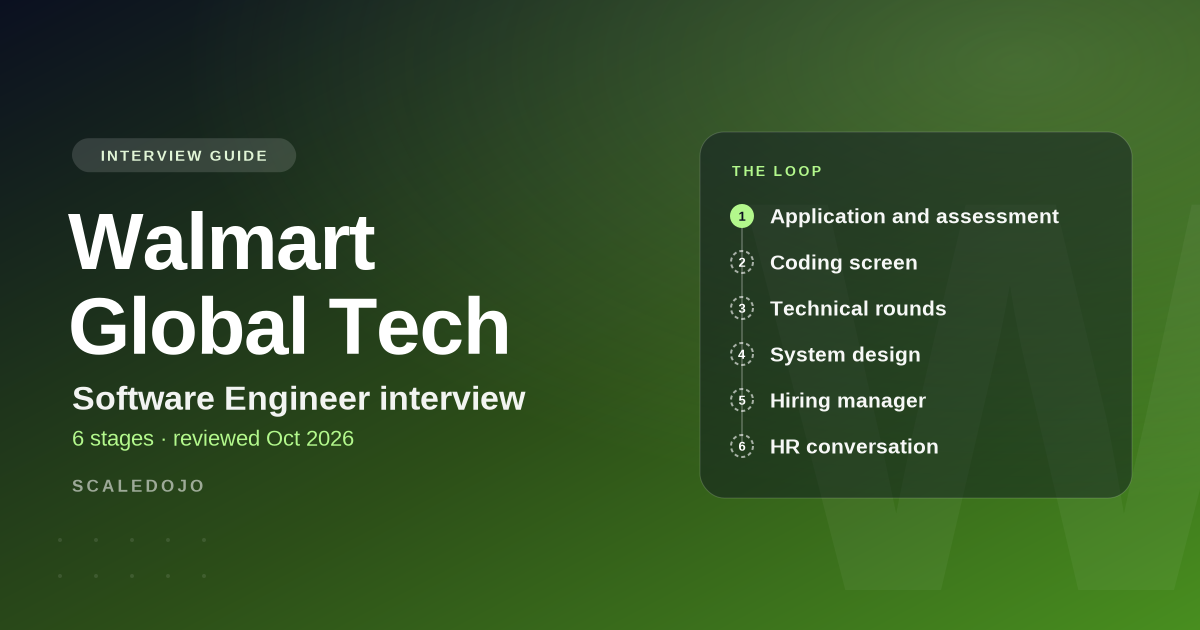
Walmart Global Tech Software Engineer Interview Guide
What Walmart Global Tech software engineer interviews usually involve: coding, technical and design rounds, the hiring manager, and a prep plan.
Browse all 248 articles
- Database Schema Design Interview Questions (With Answers)
- Best System Design Platforms to Practice in 2026 (Compared)
- The Messy Data Day: Reconciling Two Customer Systems
- Deploying an LLM Feature at a Customer: The Checklist
- Scoping a Vague Customer Problem: Questions Before Code
- What Is a Forward Deployed Engineer? The Role Explained
- Why Choose ScaleDojo? A System Design Practice Platform with 10 Hands-On Features
- Forward Deployed Engineer Interview Prep: Decomposition and System Design Guide
- System Design Interviews in 2026: What Changed and How to Prepare
- LLM Evals & Guardrails in System Design Interviews: What to Say
- Design an Agentic RAG System: When the Agent Drives Retrieval
- Walmart Global Tech Software Engineer Interview Guide
- Flipkart Software Engineer Interview: Every Round, Explained
- Intuit Software Engineer Interview: Every Round, Explained
- Snowflake Software Engineer Interview: Every Round, Explained
- Databricks Software Engineer Interview: Every Round, Explained
- Shopify Software Engineer Interview: Every Round, Explained
- Spotify Software Engineer Interview: Every Round, Explained
- Atlassian Software Engineer Interview: Every Round, Explained
- NVIDIA Software Engineer Interview: Every Round, Explained
- Oracle Software Engineer Interview: Every Round, Explained
- Salesforce Software Engineer Interview: Every Round, Explained
- Adobe Software Engineer Interview: Every Round, Explained
- Airbnb Software Engineer Interview: Every Round, Explained
- Apple Software Engineer Interview: What to Expect
- PayPal Software Engineer Interview: Every Round, Explained
- LinkedIn Software Engineer Interview: Every Round, Explained
- Stripe Software Engineer Interview: Every Round, Explained
- SOLID Principles: A Practical Guide with Real-World Examples
- LLD: Master the Building Blocks of Low-Level Design
- Caching Strategies: Invalidation, Placement, and Real-World Trade-offs
- The Top 6 System Design Learning Platforms in 2026
- API Gateway, BFF, tRPC, and the Multi-Protocol Architecture
- AsyncAPI, CloudEvents, and the Transactional Outbox Pattern
- AMQP, Kafka, and Event Sourcing: The Async API Story
- Protocol Buffers, gRPC, and HTTP/2: The Binary Wire Protocol Story
- Apollo, Subscriptions, and Federation: GraphQL Grows Up
- GraphQL: How Facebook's Mobile Crisis Created a New Query Language
- Stripe, Swagger, and OAuth 2.0: API Design Grows Up
- OAuth, Webhooks, and Twilio: The API Economy Takes Shape
- JSON, Twitter, and the Richardson Maturity Model: REST Goes Mainstream
- Table Partitioning, Event Sourcing, Row-Level Security, and Vector Schemas
- Fielding, Bezos, and Flickr: How REST Went from Dissertation to Mandate
- UUID vs Auto-Increment, JSONB, and Schema Migrations: System-Wide Decisions
- Sharding, Replication, and Multi-Tenancy: Schema Design for Scale
- State Machines, Idempotency Keys, and Audit Trails in Database Schemas
- Double-Entry Bookkeeping, Soft Deletes, and RBAC: Real-World Schema Patterns
- SOAP, WSDL, and WS-*: Inside the Enterprise XML Cathedral
- HTTP/1.1 and XML: The Protocol That Runs the Internet
- HTTP/0.9, CGI, and HTTP/1.0: The Birth of the Web API
- CORBA, DCOM, and Java RMI: The Platform Wars That Made REST Inevitable
- ARPANET, FTP, and Sun RPC: How Machines First Learned to Talk
- Partial Indexes, Expression Indexes, and Strategic Denormalization
- B-Trees, Query Optimizers, and Index Design: How Databases Find Anything Fast
- Trees in SQL: Adjacency List, Materialized Path, and When to Use a Graph Database
- Many-to-Many Relationships, Self-Referencing, and Polymorphic Data Modeling
- Primary Keys, Foreign Keys, Constraints, and Triggers: How Databases Enforce Reality
- Database Normalization Explained: 1NF Through BCNF and Temporal Data
- Observability, Feature Flags, and Platform Engineering: The Modern Operations Toolkit
- Oracle, ANSI SQL, and PostgreSQL: How the Relational Model Became the Industry
- Hamilton's Paper and the SRE Book: How to Actually Operate Systems at Scale
- Codd's Relational Model, SQL, and the ER Diagram: The Foundations of Every Schema
- Edge Computing, Multi-Region Active-Active, and Geo-Sharding: The Planet-Scale Playbook
- CODASYL, Flat Files, and the Pre-Relational World
- CDNs and CRDTs: How Global Systems Handle Distance and Conflict
- Spanner, Spark, and Time-Series DBs: Three Distributed Systems That Changed What Is Possible
- Disk Storage, Hierarchical Databases, and the Birth of Data Navigation
- LSM-Trees and Elasticsearch: The Storage Engines Behind Write-Heavy Systems
- Circuit Breakers and Service Mesh: How Microservices Stay Resilient
- Chaos Engineering, Docker, and Kubernetes: Building Systems That Survive Failure
- Netflix's Cloud Migration and the Twelve-Factor App: How Microservices Were Born
- Lambda Architecture, WebSockets, and Flink: The Real-Time Processing Playbook
- The Log and Apache Kafka: The Append-Only Data Structure That Changed Everything
- Cassandra, the NoSQL Explosion, and CAP Revisited: When Databases Multiplied
- The Dynamo Paper: How Amazon Built a Database That Never Goes Down
- GFS, MapReduce, BigTable, and Chubby: Four Papers That Built Modern Infrastructure
- Google's First Architecture and the CAP Theorem: The Foundations of Distributed Systems
- The World Wide Web and Three-Tier Architecture: How the Internet Got Its Shape
- Multics, the Relational Model, and ACID: How Databases Got Their Guarantees
- MoE, Guardrails, Observability, and Reasoning Models: The Production Frontier
- LoRA, QLoRA, and LLaMA: How Fine-Tuning Became Accessible to Everyone
- vLLM, PagedAttention, and Serving LLMs at Scale
- Multi-Agent Systems, MCP, and AI Safety: Building Agents That Don't Go Rogue
- LangChain and LlamaIndex: The Frameworks That Shaped GenAI Development
- ReAct, Function Calling, and Tool Use: How LLMs Learned to Do Things
- Advanced RAG: Hybrid Search, Reranking, and How to Actually Evaluate Quality
- Vector Databases and Chunking Strategies: The Foundation of Production RAG
- LLM Hallucination and RAG: Why AI Makes Things Up and How Retrieval Fixes It
- ChatGPT and GPT-4: The Consumer AI Moment That Changed Everything
- RLHF and InstructGPT: How AI Learned to Follow Instructions
- GPT-2, GPT-3, and Scaling Laws: When Making It Bigger Actually Worked
- GPT-1 and BERT: The Pre-training Revolution That Made Modern AI Possible
- The Transformer Architecture: Attention Is All You Need, Explained From the Ground Up
- Seq2Seq and the Attention Mechanism: How Neural Networks Learned to Translate
- Word2Vec: How Words Became Vectors and Changed NLP Forever
- AlexNet, GPUs, and the Deep Learning Moment That Changed Everything
- LSTMs, Neural Language Models, and the Memory Problem That Shaped Modern AI
- The Perceptron, Backpropagation, and the AI Winters That Almost Killed Neural Networks
- GenAI Pipeline Lab: Build AI Architectures From Zero to Production
- Generative AI Examples & Complete Beginner Guide: LLMs to Agents
- RAG and Vector Databases: The Complete System Design Guide
- Scale From Zero to Millions of Users: Complete System Design Guide (2025)
- How to Drive the Design: Taking Ownership of the Interview Room
- Depth vs Breadth in System Design: Knowing What to Explore
- Time Management in 45-Minute System Design Interviews
- Whiteboard Communication: Drawing a System Design That Makes Sense
- Trade-off Articulation: Sounding Like an Architect, Not a Textbook
- Back-of-Envelope Estimation: The Art of Smart Calculation
- The RESHADED Framework: A Complete Mental Map for System Design
- Global CDN and Edge Computing: Putting Intelligence at the Network Edge
- Multi-Cloud Architecture: Avoiding Vendor Lock-In at Planetary Scale
- AI and ML Infrastructure at Scale: Serving Models to Billions of Users
- Chaos Engineering: Breaking Things on Purpose to Build Unbreakable Systems
- CRDTs for Conflict-Free Replication: Mathematics Prevents Data Conflicts
- Google Spanner: The Globally Consistent Database That Should Not Exist
- Multi-Region Active-Active Deployment: Being Everywhere at Once
- Design an E-Commerce Platform: The System Behind Every Online Store
- Multi-Tenant SaaS Architecture: One Platform, Thousands of Customers
- Design a Distributed Task Scheduler: Running Billions of Cron Jobs
- Design Ticketmaster: Handling the Taylor Swift Problem
- Design a Food Delivery System: DoorDash Engineering Under the Hood
- Design Google Docs: Collaborative Editing for Millions
- Design Google Maps: Navigation System Design for a Billion Users
- Design a Notification System: Delivering Billions of Alerts Reliably
- Design a Web Crawler: Mapping the Internet Systematically
- Uber System Design: Real-Time Ride Matching at Global Scale
- Design YouTube: Video at Planetary Scale
- Design WhatsApp: Real-Time Messaging for 2 Billion Users
- Design Instagram: Photo Sharing at a Billion Users
- Design Twitter/X Feed: The Hardest Feed System at Scale
- URL Shortener System Design: The Classic Interview Question
- Regulatory Compliance Schemas: Designing Databases That Pass Audits
- Risk and Margin Calculations in Trading Systems
- Multi-Currency Systems: Engineering Money Across Borders
- Idempotent Transaction Handling: Preventing Duplicate Charges at All Costs
- Double-Entry Ledger Design: The 500-Year-Old System That Powers Banking
- Payment Processing Architecture: How Stripe Moves Money Safely
- Polyglot Persistence: Using the Right Database for Each Job
- Data Lakes and Lakehouse Architecture: Analytics at Petabyte Scale
- Edge Functions: Running Code at the CDN Layer
- CDN Architecture: How Content Delivery Networks Serve the World
- Block vs File vs Object Storage: Choosing the Right Storage Abstraction
- Object Storage Design: How Amazon S3 Stores Exabytes of Data
- Content Personalization: Showing Every User a Different Experience
- Ranking Algorithms: How Search Results Are Ordered
- Recommendation Engines: How Netflix Knows What You Will Watch Next
- News Feed Fanout: Push vs Pull and How Facebook and Twitter Scale Their Feeds
- Search Autocomplete and Typeahead: The Engineering Behind Instant Suggestions
- Full-Text Search with Elasticsearch: From Queries to Millions of Results in Milliseconds
- Anomaly Detection in Production Systems: Catching Problems Before Users Notice
- Alerting Strategies: Getting Woken Up Only When It Actually Matters
- Log Aggregation at Scale: Managing Billions of Log Lines
- SLIs, SLOs, and SLAs: Making Reliability Measurable and Contractual
- Distributed Tracing with OpenTelemetry: Following Requests Across 20 Services
- The Three Pillars of Observability: Metrics, Logs, and Traces
- The Outbox Pattern: Guaranteed Message Delivery Without Dual Writes
- Retry with Exponential Backoff: Handling Transient Failures Gracefully
- Circuit Breaker and Bulkhead: Stopping Cascading Failures
- Saga Pattern: Managing Distributed Transactions Without Two-Phase Commit
- Event Sourcing: Your Database as an Immutable Log of What Happened
- CQRS: Separating Reads and Writes for Maximum Performance
- Exactly-Once Processing: The Hardest Problem in Distributed Streaming
- CRDTs and Operational Transforms: Collaborative Editing Without Conflicts
- Video Streaming Architecture: How HLS and DASH Deliver Video to Billions
- Real-Time Analytics Pipelines: From Raw Events to Live Dashboards
- Kafka Streams and Apache Flink: Stream Processing at Massive Scale
- WebSocket Architectures at Scale: Handling Millions of Persistent Connections
- Bidirectional Streaming: Full-Duplex Communication with gRPC
- Protobuf Schema Evolution: Evolving gRPC Contracts Safely
- GraphQL Schema Federation: Composing a Unified Graph from Multiple Services
- Real-Time GraphQL Subscriptions: Push Updates to Clients
- Relay-Style Connections and Pagination in GraphQL
- GraphQL Schema-First Design: Defining Your API Contract Before Code
- PACELC Theorem: Beyond CAP to Everyday Trade-offs
- Vector Clocks and Conflict Resolution: Tracking Causality in Distributed Systems
- Distributed Locking with Redlock: Coordinating Across Nodes
- Quorum Reads and Writes: Tuning Consistency in Distributed Databases
- Strong, Eventual, and Causal Consistency: The Consistency Spectrum
- CAP Theorem Deep Dive: The Fundamental Trade-off of Distributed Systems
- Strangler Fig Migration: From Monolith to Microservices Gradually
- Service Mesh: Infrastructure for Service-to-Service Communication
- API Gateway Patterns: The Front Door to Your Microservices
- Service Discovery and Registration: How Services Find Each Other
- Domain-Driven Design: Drawing the Right Service Boundaries
- Monolith vs Microservices: Making the Right Architecture Choice
- GraphQL and gRPC Foundations: Beyond REST
- Long-Running Operations: Handling Async Work in Synchronous APIs
- File Upload APIs: Handling Binary Data in Web Services
- Bulk Operations: Designing APIs That Handle Thousands of Items Efficiently
- Idempotency Keys: Making Retries Safe in Distributed Systems
- Webhook Design: Letting Your API Push Events to Clients
- Cross-Shard Queries: Handling Data That Spans Multiple Shards
- Multi-Master Replication: Writing to Multiple Servers Simultaneously
- Change Data Capture: Streaming Database Changes in Real-Time
- Shard Key Selection: The Most Important Decision in Database Sharding
- Horizontal Sharding: Splitting Your Database Across Multiple Servers
- Primary-Replica Replication: Making Databases Highly Available
- Backpressure Handling: What Happens When Consumers Cannot Keep Up
- Event Sourcing Explained: Store What Happened, Not Just Current State
- Kafka Partitions and Consumer Groups: Scaling Event Streaming
- Dead Letter Queues: Where Failed Messages Go to Be Investigated
- Message Delivery Guarantees: At-Least-Once vs Exactly-Once
- Pub/Sub vs Point-to-Point Messaging: Two Models for Decoupling Services
- OWASP Top 10 for APIs: The Security Threats Every Developer Must Know
- RBAC and ABAC: Access Control Models for APIs
- API Rate Limiting and Throttling: Protecting Your API from Abuse
- JWT Authentication and Refresh Rotation: Stateless Authentication That Works
- OAuth 2.0 Flows: Delegated Authorization Made Practical
- API Key Management: The Simplest Form of API Authentication
- Connection Pooling: Why Opening a New Connection Every Time Is Terrible
- Horizontal vs Vertical Scaling: Growing Your System's Capacity
- Health Checks and Circuit Breakers: Building Self-Healing Systems
- Consistent Hashing: Distributing Data Without Reshuffling Everything
- Load Balancing Algorithms: Round-Robin, Weighted, and Least Connections
- L4 vs L7 Load Balancers: Understanding Network Layers in Practice
- TTL Tuning and Cache Stampede Prevention: Advanced Caching Reliability
- Redis and Memcached Patterns: Practical Caching in Production
- Cache Invalidation Strategies: The Hardest Problem in Computer Science
- CDN Edge Caching: Serving Content from Everywhere at Once
- Write-Through vs Write-Back Caching: Choosing Your Write Strategy
- Cache-Aside Pattern: The Most Common Caching Strategy Explained
- Request and Response Schemas: Designing API Contracts That Last
- API Versioning: Evolving APIs Without Breaking Clients
- API Error Handling: Building APIs That Fail Gracefully
- Cursor vs Offset Pagination: Why It Matters at Scale
- HTTP Methods and Status Codes: Speaking HTTP Fluently
- RESTful Resource Modeling: Designing APIs That Make Sense
- Database Isolation Levels: Controlling Concurrent Access
- Database Normalization and Denormalization: Organizing Data for Performance
- Database Indexing: B-Trees, Hash Indexes, and Making Queries Fast
- ACID vs BASE: Two Philosophies of Data Integrity
- NoSQL Databases: When Relational is Not Enough
- Relational Databases: The Foundation Everything Else Builds On
- REST Basics and HTTP Methods: The Language of Web APIs
- WebSockets and Server-Sent Events: Real-Time Communication Patterns
- TLS/SSL Handshake: How Encryption Starts Every Secure Connection
- DNS Resolution and TTL: How the Internet Finds Anything
- HTTP/1.1 vs HTTP/2 vs HTTP/3: The Evolution of Web Communication
- TCP vs UDP: The Two Languages of the Internet
- Your First 7 Days in ScaleDojo: Beginner Hand-Holding Plan
- HLD vs LLD vs API Design: How They Work Together
- API Design Complete Beginner Blueprint: REST to Production
- LLD: Low-Level Design Complete Beginner Blueprint
- HLD: High-Level Design Complete Beginner Guide
- System Design for Beginners:A Zero to Hero Beginner Guide
- How Netflix Serves 250 Million Users Without Breaking a Sweat
- What Happens When You Type a URL and Press Enter: The Invisible Journey Explained
- How ScaleDojo Makes System Design Easy -2026 Review