
Shopify says it hires people, not resumes, and the interview is built to match. Instead of a stack of puzzles, you get a conversation about your career, a pair programming session where you build something with a Shopify developer, a deep dive into a project, and time with the people you would work with. This guide walks through each part and how to prepare.
How we put this together. The loop below comes from Shopify's own pages: its careers FAQ and a Shopify Engineering post on its technical interview process, dated July 2022. They list the stages in a slightly different order and say the order and number of interviews vary by role and team. The advice on how to prepare is ours. Shopify may have changed details since the post was written, so confirm yours with your recruiter.
The loop at a glance
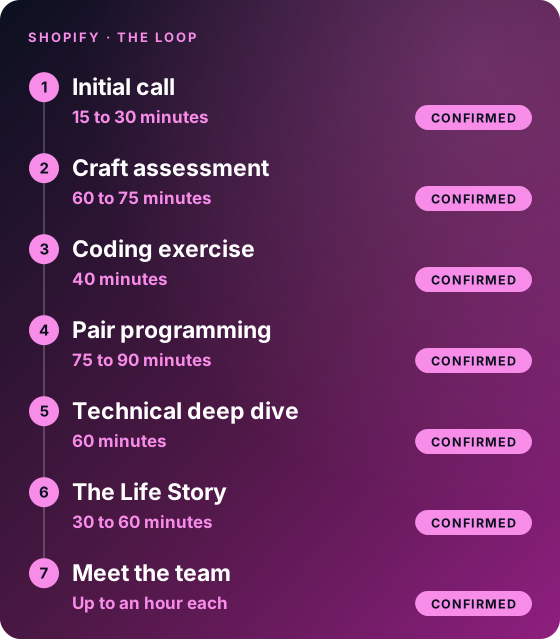
| Stage | Typical length | What happens | Where it comes from |
|---|---|---|---|
| Initial call | 15 to 30 minutes | A recruiter or hiring manager asks what you are interested in. | Careers FAQ |
| Craft assessment | 60 to 75 minutes | A person in your craft explores what you are best at and how you work. | Careers FAQ |
| Coding exercise | 40 minutes | An algorithm problem on CoderPad with a developer or data scientist. | Engineering post |
| Pair programming | 75 to 90 minutes | You drive a programming exercise with a Shopify developer. | Engineering post and FAQ |
| Technical deep dive | 60 minutes | A conversation about one or two projects you know well. | Engineering post |
| The Life Story | 30 to 60 minutes | A conversation about the themes of your career. | Careers FAQ and engineering post |
| Meet the team | Up to an hour each | Three to five future co-workers. | Careers FAQ |
For research and development roles, Shopify's FAQ says you go straight from the first call into pair programming before the Life Story. The FAQ also notes that decisions draw on feedback from team members of different seniority, and that timelines vary with the role and the number of applicants.
What makes Shopify different
- Pair programming is a main event. You write code with a developer as your partner, not an examiner. Communication, your approach, edge cases and code quality are what Shopify says it looks at.
- The Life Story is a real interview. It is a long conversation about your career, and Shopify Engineering's post names what it looks for: impact, readiness, trust, engagement and self-awareness.
- You choose your language. For most exercises any language works; front-end candidates use HTML, CSS and JavaScript.
- Projects get time. The deep dive is an hour on one or two projects you know well, covering business impact, architecture, decisions and teamwork.
Round by round
Initial call and craft assessment
A short call about what you are interested in, then an interview of 60 to 75 minutes with at least one person in your craft, about what you are best at and how you approach your work. Prepare a clear account of your strongest area, with an example, and the questions you want to ask about the team.
Coding exercise
Shopify Engineering's post describes 40 minutes of algorithm and problem solving on CoderPad with a developer or data scientist. Its tips: ask clarifying questions before you start, share your thought process, run your code often, and aim for a working solution before a perfect one.
Practise on ScaleDojo: Forge modules on Array & String Techniques, Hashing, Stacks & Queues, Recursion & Memoization, Sorting Algorithms and Trees & Binary Search Trees.
Pair programming
Seventy-five to ninety minutes working remotely with a Shopify developer. You are the driver and your partner observes and helps. Treat them as a teammate: say what you plan, ask what they think, run the code often, and think about edge cases and scale. The exercises tend to grow in steps, so leave your code easy to extend.
- Start by restating the problem and agreeing on a small first goal.
- Name your variables and functions for the reader, not for speed.
- When your partner offers a hint, use it and say so.
Practise on ScaleDojo: the LLD course on SOLID Principles and Case Studies: Marketplace & Booking Systems, and pair with a friend on a small exercise whose rules change midway.
Technical deep dive
Pick one or two projects you know inside out. Be ready to explain the business impact, the architecture, the decisions you made and why, and how you worked with others. The weak spot to prepare for is the question you did not expect: what would you do differently, and what broke.
Practise on ScaleDojo: the HLD course, especially Databases 101, Caching for Speed, Distributed Transactions & Resilience and Observability & Operating at Scale, so you can talk about trade-offs in commerce systems such as flash sales and checkout.
The Life Story
A conversation with a recruiter about the themes of your career: the problems you solved, the challenges, the decisions and the lessons. Prepare three or four chapters, each with a decision and what you learned, and be candid about a decision you would change.
Meet the team
Three to five future co-workers, up to an hour each. Depending on the role you may be asked how you would solve a problem and explain it to the team. Ask real questions; Shopify says these meetings are for both sides.
How the loop differs by level
Shopify's pages do not split the process by level, and the engineering post covers individual contributors. It notes that leadership roles have additional team-specific interviews. Ask your recruiter which stages apply to your role.
A five-week preparation plan
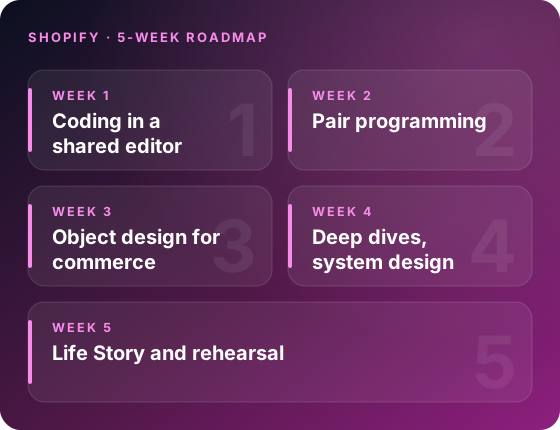
- Week 1. Forge problems in a shared editor, run often. Practise stating a plan before you code.
- Week 2. Pair on a growing exercise with a friend who changes the rules. Practise using hints.
- Week 3. Object design for carts, promotions, orders and inventory in the LLD course.
- Week 4. Prepare two projects in depth, then system design for checkout and flash sales, with two mocks.
- Week 5. Write your Life Story as chapters, say it aloud, then a full rehearsal.
The Interview plan tab in Revision builds a daily schedule from your weeks and hours, ticks off what you finish and brings your weak topics back through spaced revision. Shopify's plan is part of Pro.
Practice prompts
These are our own, written for practice. They are not questions anyone reports being asked.
- Apply a list of discount rules to a cart and return the final price, showing each rule that applied.
- Fulfil an order from the fewest warehouses given stock levels in each location.
- Design checkout for a flash sale where traffic is a hundred times normal for ten minutes.
- Design inventory so two shoppers can never buy the last item.
- Design a GraphQL API for products and orders that stops one query from costing too much.
- Walk me through your career as a few chapters and what you learned in each.
Questions to ask your recruiter
- Which stages will I have, and in what order?
- Is the pair programming in my own editor, and which languages are allowed?
- Which projects should I prepare for the technical deep dive?
- Who will I meet in the team interviews?
- How should I prepare for the Life Story?
What we know and what we do not
Shopify's FAQ and engineering post confirm the stages, their lengths and what they look for. The post is from 2022 and Shopify says the order and number of interviews vary, so check yours with your recruiter. We have not included any question a candidate says they were asked, and nothing here is a promise about what you will see. If your recruiter tells you something different, believe your recruiter. Last reviewed in October 2026.