
Search for what changed in system design interviews and you find confident lists, most of them without a source. This guide keeps three things apart: what companies have published about their own interviews, what we make of it, and what has not changed at all. Where we are giving our judgment, we say so. Last reviewed in October 2026.
What companies themselves say
These come from the companies' own pages, as of this review. Companies change their processes, so open the page before you rely on it, and ask your recruiter, who always has the final word.
| Company | What its own pages describe | Read it yourself |
|---|---|---|
| Meta | Its hiring page says select roles include an authorized AI assistant in the coding interview. Its full loop guide asks candidates not to use unauthorized outside assistance, AI tools included. | Meta's hiring page, and our Interview plan |
| DoorDash | Describes rebuilding its engineering interviews around AI. A 60-minute working session in your own editor with integrated AI tools, scored on how you get oriented, use AI and verify its output, debug, manage scope and communicate trade-offs. | DoorDash's post, and our Interview plan |
| Intuit | A 60-minute session, about half on product design and half on AI solutions in advanced products, plus a 75-minute design presentation (blog post dated July 22, 2025). | Intuit's post, and our Intuit guide |
| NVIDIA | For its coding exercise, using unapproved outside tools such as ChatGPT disqualifies a candidacy. | NVIDIA's page, and our NVIDIA guide |
| Shopify | Pair programming of 75 to 90 minutes with a Shopify developer: you write the code, your partner observes (engineering post dated July 7, 2022). | Shopify Engineering's post, and our Shopify guide |
| Flipkart | A 120-minute machine coding round: you write executable code on your laptop for a problem the interviewer describes, then demonstrate it. | Flipkart's SDE guide, and our Flipkart guide |
| Atlassian | Two coding interviews of up to 60 minutes in your own IDE, a 60-minute system design interview, a management interview and a values interview (backend guide, 2023). | Atlassian's backend guide, and our Atlassian guide |
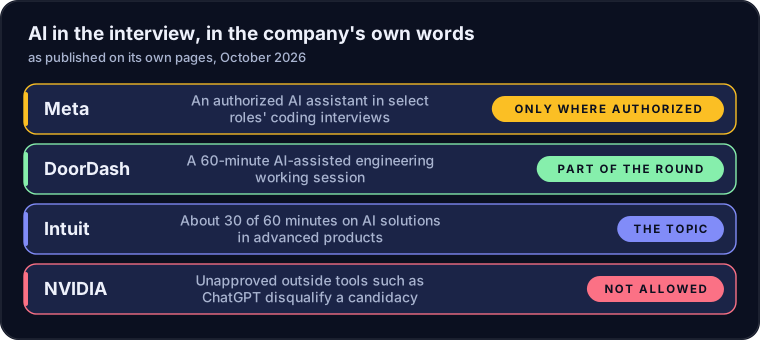
Three things stand out in what is published:
- AI is treated three different ways. It is part of the round at some companies, the topic of the round at others, and forbidden at others. So the question to ask is which one applies to you.
- Several loops are built around working sessions. Pair programming, machine coding, a design presentation and a session in your own editor all ask you to produce and explain something live, not only to solve a puzzle on a whiteboard.
- Loops differ a lot in length and shape. The recruiter's description of your loop matters more than any general advice, including ours.
What we make of it
The rest is our judgment, not a published rubric. No company publishes its question list, so we cannot tell you how often any topic is asked. This is our interpretation of the evidence above, together with what learners on ScaleDojo work on.
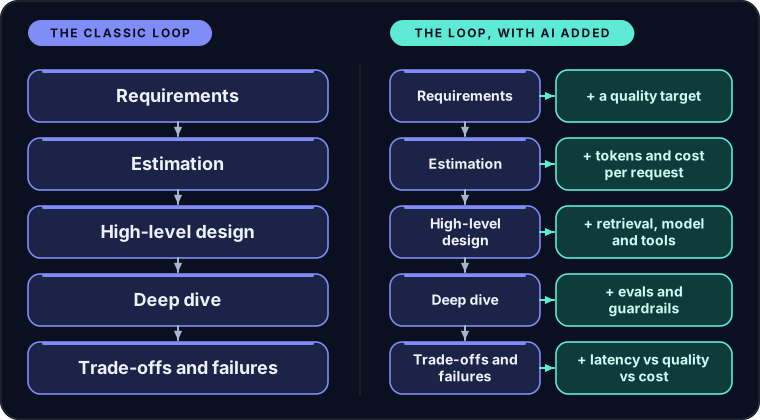
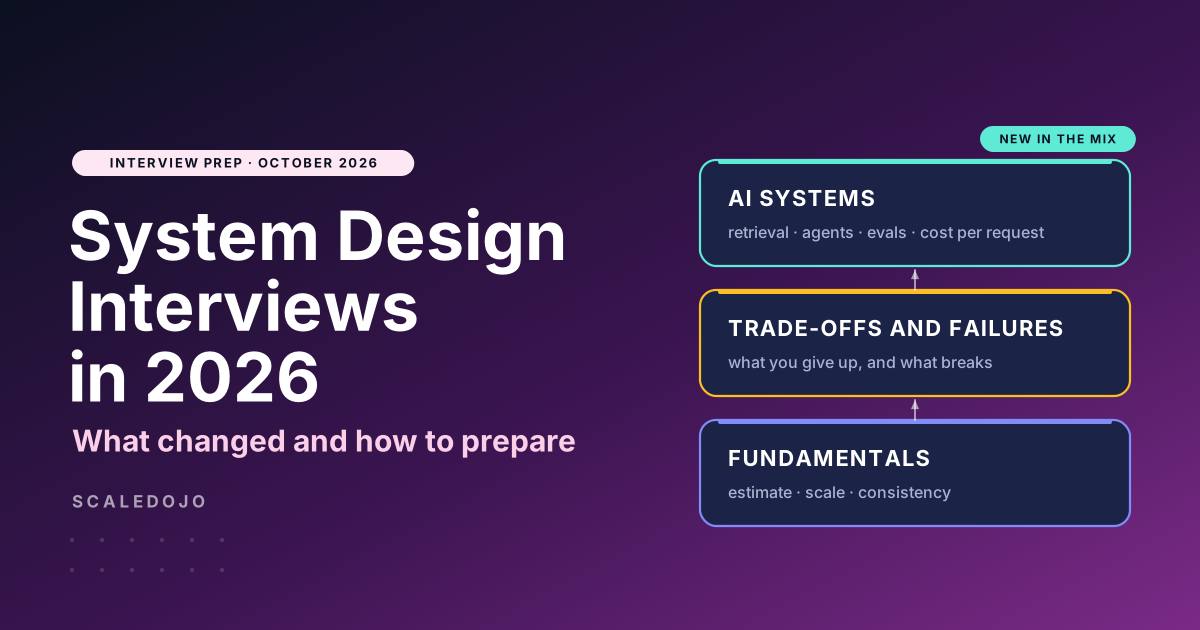
- AI systems are a normal design prompt. A retrieval-based assistant, an agent with tools or an evaluation pipeline is a reasonable thing to be asked to design, next to a news feed or a rate limiter. It is why the HLD Lab has a group of AI-infrastructure levels and why ScaleDojo has a full GenAI Lab.
- The trade-off and failure discussion carries more weight. It always separated candidates. With an AI component it gains new numbers to defend: latency per request, cost per request and how you measure quality. Design an Agentic RAG System and LLM Evals & Guardrails walk through two of them.
- Working well with an assistant is becoming a skill of its own, where it is allowed. DoorDash scores how you use AI and verify its output. The safe reading: be able to explain and defend every line, whether you or an assistant wrote it, and be ready to work without the assistant where a company forbids it.
What has not changed
- The loop. Clarify, estimate, sketch, find the bottleneck, name the trade-off. How to Structure Any Design Answer walks through it with a time budget.
- The toolbox. Caching, queues, replication, sharding, idempotency and consistency trade-offs still carry most designs, including AI ones: an AI feature is still a service with a database, a cache and a queue.
- Thinking aloud with numbers. Interviewers still want to hear your reasoning, and a rough estimate beats a confident guess.
- Short interviews. Meta's guide describes a loop of 4 to 6 interviews of 45 minutes, so a design answer still has to fit in well under an hour.
How to prepare: a map
| The shift | What to practice | Where in ScaleDojo |
|---|---|---|
| The fundamentals | Estimation, caching, queues, replication, sharding | The HLD Learn course, then the HLD Lab, starting at Level 1 |
| AI-system prompts | RAG, agents, evaluation, serving cost | The GenAI Learn course, the GenAI Lab, and HLD Level 50 to Level 54 |
| Failure and cost talk | What breaks, and what a request costs | Murphy's Lab in the HLD Lab, and Cost Controls & Budget Guardrails |
| Thinking aloud under time | A timed answer with no hints | HLD Interview mode, which hides hints and turns requirements into questions you must ask, and the Mock Arena |
| Remembering it all | Spaced revision and a company-specific plan | Revision and its Interview plan |
| With or without an assistant | Writing, explaining and debugging code yourself | The Forge Algorithm Lab: if you lean on an assistant for everything, practice here first |
A plan you can adjust
Early weeks are mostly learning and levels. Late weeks are mostly timed answers and revision. The planner below applies that rule to your own weeks and hours, and lets you tilt the mix toward classic fundamentals or toward AI systems depending on the role.
A planner. The split is our judgment, a starting point and not a promise about any company's interview.
Questions to ask your recruiter
- Which rounds are in my loop, and how long is each one?
- Is there a system design round, and is it infrastructure design or product design?
- Is an AI assistant available, allowed or forbidden in each round?
- Can I use my own editor and tools?
- Is there a round about AI systems or about working with AI tools?
- What does the team look for beyond the rounds?
What we know and what we do not
We know what the companies above publish, as of October 2026, and each row links to the page it comes from. We do not know how often any topic is asked, and no company shares its rubric. The shifts in "What we make of it" are our interpretation of that evidence and of the questions our own learners work on. If your recruiter tells you something different, believe your recruiter. Last reviewed in October 2026.