
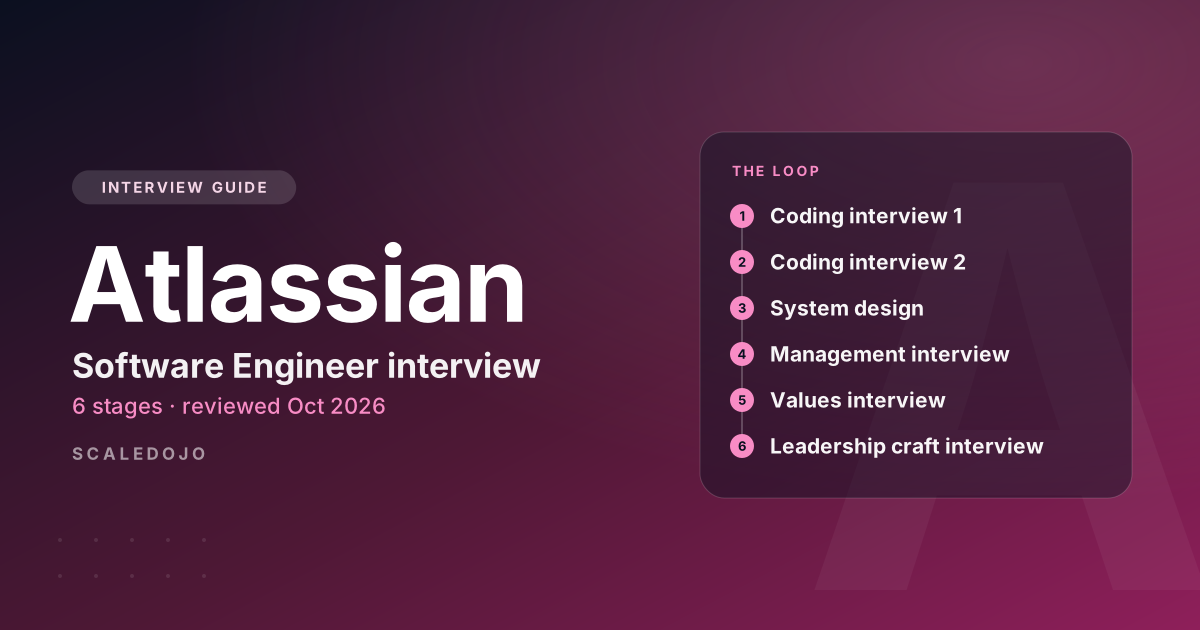
The Atlassian software engineer interview process is laid out in detail by the company itself: Atlassian publishes interview guides for its engineers, with the rounds, their lengths and what each one assesses. That makes preparation easier, and it means the useful question is not what to expect but how to do each round well. This guide goes through the loop in order, round by round, with practice advice for each.
How we put this together. The loop below comes from Atlassian's own documents: its backend engineering interview guide, its principal backend engineer guide (both 2023) and its early careers interview guide. The advice on how to prepare is ours. Atlassian says it may amend its processes at any time, so confirm yours with your recruiter, and note that the guides are for backend roles; other crafts have their own.
The loop at a glance
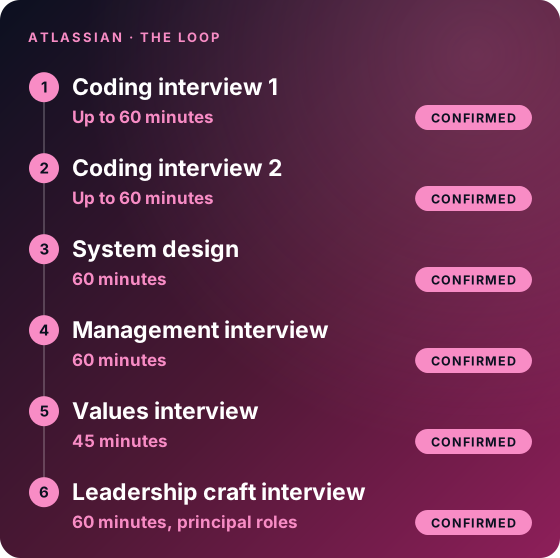
The Atlassian loop as Atlassian publishes it. Lengths and order can change, so confirm yours with your recruiter.
Interview | Length | What it covers | Where it comes from |
|---|---|---|---|
Coding interview 1 | Up to 60 minutes | Write and run code in your own IDE, shared over Zoom: coding skills, code quality, conceptual thinking. | Backend guide |
Coding interview 2 | Up to 60 minutes | The same format, with a different problem. | Backend guide |
System design | 60 minutes | Design a solution to an established problem: depth, breadth, decisions, performance and reliability. | Backend guide |
Management interview | 60 minutes | Scenario-based questions with an engineering manager on outcomes, lessons, conflict and initiative. | Backend guide |
Values interview | 45 minutes | Behavioural questions on how your actions line up with Atlassian's values. | Backend guide |
Leadership craft interview | 60 minutes | For principal engineers, in place of the management interview: engineering leadership on large projects. | Principal guide |
Atlassian's early careers page describes a different shape: a role-specific assessment, such as a coding test for software engineers, within a set time, then three to four virtual interviews covering craft, leadership and values. The principal guide says its interviews are scheduled in three stages, with your recruiter in touch after each.
What makes Atlassian different
You code in your own setup. Atlassian asks you to bring an IDE and testing framework you know and to share your screen. If you cannot, it prepares an online environment, but you need to ask beforehand.
Testing is part of the answer. The guide says best practice and testing are crucial, and recommends brushing up on a test-driven approach. A debugger is welcome and encouraged.
More than one solution is a feature. Atlassian asks you to show other approaches and why yours is the best fit, because problems rarely have a single answer.
Values are a full interview. The values interview is 45 minutes on its own, with questions built around Atlassian's five values.
Round by round
Coding interviews
Each is capped at 60 minutes and shows your coding skills, code quality and conceptual thinking. Atlassian also looks for adaptability, how you handle blockers and how you communicate. Explaining your thinking matters as much as the result, so talk as you work.
Set up the IDE, your test runner and screen sharing a day early. Join about ten minutes before the start.
Write a test first or alongside, even for a small function.
Use the debugger when something is wrong instead of guessing.
Once it works, name a second approach and say why you did not choose it.
Practise on ScaleDojo: Forge modules on Measuring Code, Array & String Techniques, Hashing, Stacks & Queues, Recursion & Memoization and Graph Fundamentals, with a test for every solution.
System design
Sixty minutes to design a solution to an established technical problem on a whiteboard, paper or a drawing tool you share. Atlassian says to start with fundamentals and build in complexity, to ask clarifying questions first, and to keep the customer in mind, including how the solution performs and scales. Interviewers look at your thinking, your decisions and operational concerns such as performance and reliability.
Practise on ScaleDojo: the HLD course, especially APIs, Done Right, Microservices & Service Architecture, Observability & Operating at Scale and the Capstone Case Studies, then mocks in the Mock Arena.
Management interview
Sixty minutes with an engineering manager, scenario-based and structured around four areas: driving outcomes across the software development lifecycle, applying and sharing lessons learned, managing conflict, and taking initiative and leading. Atlassian says to choose projects where you had measurable impact and felt stretched; they do not have to be your best or most recent.
Leadership craft interview (principal)
For principal engineers this replaces the management interview. It focuses on a project, or a few, where you showed engineering leadership: owning outcomes across large projects, the direction you gave project teams, and the wider impact of how you share knowledge and improve ways of working. It does not go deep on architecture, but you should be able to explain why you chose it and how you involved others.
Values interview
Forty-five minutes of behavioural questions about how your thinking and actions line up with Atlassian's values. It publishes five: Be the change you seek; Play, as a team; Don't #@!% the customer; Open company, no bullshit; and Build with heart and balance. Prepare at least one true story for each, with what you did and what it cost.
Practise on ScaleDojo: the LLD course on SOLID Principles and Behavioral Patterns for the design of engines like workflows and automation rules, which suit Atlassian's products.
How the loop differs by level
Atlassian's guides do not name levels for the standard backend loop. The principal guide differs in one way: a leadership craft interview takes the place of the management interview, and the stages are scheduled in three steps. Early-career candidates start with a timed assessment and have three to four interviews. Ask your recruiter which guide applies to you.
A five-week preparation plan
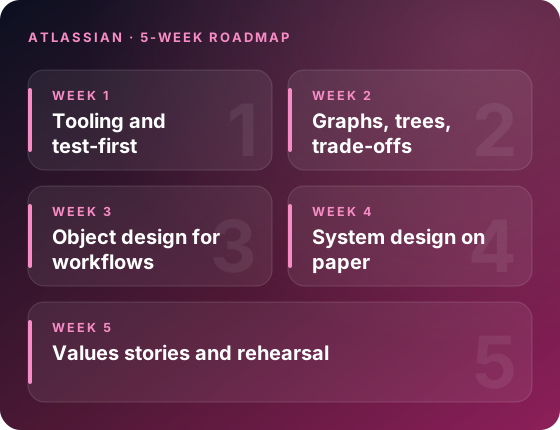
A 5-week order of preparation for the Atlassian loop. Stretch it or squeeze it to the time you have.
Week 1. Set up your IDE, test runner and screen sharing. Solve problems in Forge test-first.
Week 2. Graphs, trees, hashing and sorting. For each, name a second solution and its trade-off.
Week 3. Object design for workflow and automation engines, in the LLD course.
Week 4. System design on whiteboard or paper: issue tracking, a wiki, notifications, with two timed mocks.
Week 5. Five values stories and your management or leadership projects, said aloud, then a full rehearsal.
The Interview plan tab in Revision builds a daily schedule from your weeks and hours, ticks off what you finish and brings your weak topics back through spaced revision. Atlassian's plan is part of Pro.
Practice prompts
These are our own, written for practice. They are not questions anyone reports being asked.
Validate a move of a task between states against a table of allowed transitions, test first.
Return a valid order to complete tasks that depend on each other, or report a cycle.
Design an issue tracker with projects, custom fields and workflows.
Design a notification digest that combines activity from several products.
Design a workflow engine with states, transitions and conditions that admins can edit.
Tell me about a time you disagreed with a plan and said so openly.
Questions to ask your recruiter
Which guide applies to my role and level?
May I use my own IDE and testing framework, and how do I share my screen?
Are the interviews scheduled in stages, and when will I hear after each?
Is the system design on a whiteboard, paper or a shared drawing tool?
How should I prepare for the values interview?
What we know and what we do not
Atlassian's guides confirm the rounds, their lengths and what each assesses. They are for backend roles and dated 2023, and Atlassian says it may amend its processes at any time, so check yours with your recruiter. We have not included any question a candidate says they were asked, and nothing here is a promise about what you will see. If your recruiter tells you something different, believe your recruiter. Last reviewed in October 2026.