
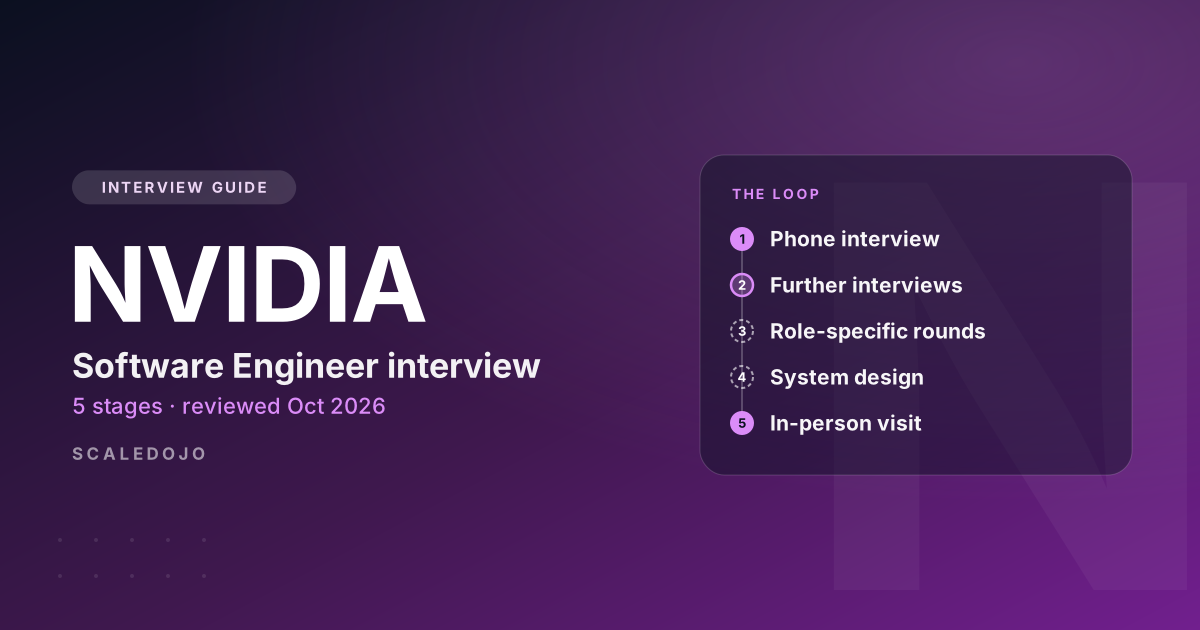
NVIDIA's interviews are short and varied. Its own page describes interviews of 30 to 60 minutes, and public accounts agree on the other thing that defines the loop: there is no single template, because each team's engineers shape their own questions. This guide covers what NVIDIA says, what candidates describe, and how to prepare when you cannot be sure what is coming.
How we put this together. NVIDIA's How We Hire page describes the stages, the interview formats and lengths, a coding exercise for technical roles, and a rule against unapproved outside tools. It does not describe how many interviews there are or what they cover. The rest is the shape several public candidate accounts agree on, read in October 2026. NVIDIA has not confirmed it.
The loop at a glance
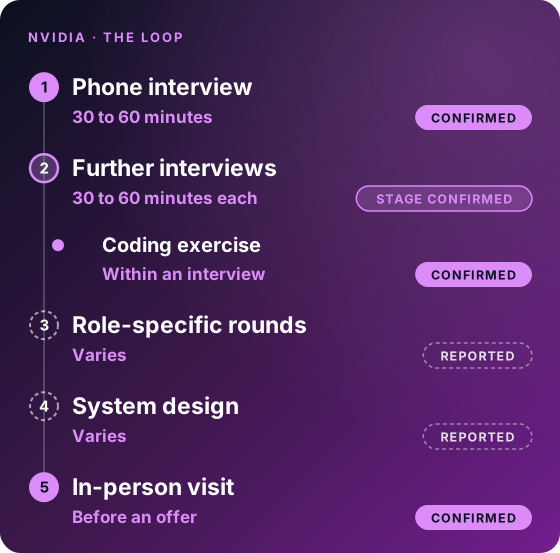
| Stage | Typical length | What happens | How sure are we |
|---|---|---|---|
| Phone interview | 30 to 60 minutes | A first conversation, with a coding exercise for many technical roles. | NVIDIA confirms the format and length |
| Further interviews | 30 to 60 minutes each | One-on-one, small-group or panel interviews, virtual or in person. | NVIDIA confirms the format and length; counts are reported |
| Coding exercise | Within an interview | HackerRank, a whiteboard or a laptop NVIDIA provides. | NVIDIA confirms it for technical roles |
| Role-specific rounds | Varies | Your past work and the technical concepts of the team: systems, embedded, architecture or machine learning. | Reported |
| System design | Varies | More often in the final round and at higher levels. | Reported |
| In-person visit | Before an offer | An office visit that NVIDIA says is required before an offer is considered. | NVIDIA confirms it |
Accounts describe a phone screen followed by about four to six interviews, with the mix set by the team. Interns, NVIDIA says, usually have phone interviews only. After the final round NVIDIA says candidates usually hear back within a few weeks.
What makes NVIDIA different
- There is no template. Accounts stress that questions depend on the interviewer. Prepare the fundamentals widely, then ask your recruiter about your team.
- Outside tools can end your candidacy. NVIDIA says using unapproved outside tools, such as ChatGPT, during an interview results in disqualification. Do not use any tool you were not told you could.
- C++ and performance are common. Accounts say C++ is widely used, so expect to write it or discuss it, along with memory, concurrency and speed. Role-specific rounds follow what the team builds.
- Interviews are short. With 30 to 60 minutes each, you have little time to warm up. Start with the approach, not with background.
Round by round
Phone and video interviews
Expect a conversation about your experience and, for many technical roles, a coding exercise. NVIDIA's advice is to talk through your thinking at every step and to listen for hints: interviewers often nudge candidates who are close or drifting. Have five or more questions about the role, project and team ready.
Coding
Accounts describe medium-difficulty problems on arrays, strings, trees and object-oriented design, often in C++. Short interviews reward a clean first answer, so practise the shape of a good one: clarify, state the approach and its cost, code, then test.
- Know your language's standard library well enough not to look things up.
- Be ready to discuss memory: what you allocate, what you copy, and what you could avoid.
- Explain time and space cost without being asked.
Practise on ScaleDojo: Forge modules on Measuring Code, Stacks & Queues, Linked Lists, Heaps & Priority Queues, Sorting Algorithms and Trees & Binary Search Trees, then Graph Algorithms and 1D Dynamic Programming.
Role-specific rounds
These follow the team: a systems team asks about operating-system and concurrency concepts, an embedded team about devices and constraints, a machine-learning team about models and data. Ask your recruiter what the team builds, then refresh the concepts that team uses every day and be ready to go deep on your own past projects.
Practise on ScaleDojo: the LLD course on Concurrency for LLD and Case Studies: Physical Systems, and the GenAI course on Transformers Under the Hood and Serving, Caching & Gateways if the role is about AI systems.
System design
Accounts place a design round in the final stage for many roles, more often at higher levels, covering scalability, reliability and efficiency. NVIDIA's products suggest useful practice: job scheduling on shared hardware, telemetry pipelines, low-latency streaming and model serving. That is our suggestion, not a list of questions.
Practise on ScaleDojo: the HLD course, especially Caching for Speed, Asynchronous Systems, Real-Time Systems and Observability & Operating at Scale, then mocks in the Mock Arena.
In-person visit and the decision
NVIDIA says an in-person visit comes before an offer is considered, and that it offers an optional, non-binding 15-minute chat with a member of an employee community group. Use the visit to meet the people you would work with and ask about the work.
How the loop differs by level
NVIDIA's page does not split the process by level, apart from saying interns usually have phone interviews only. Our reading, not an NVIDIA statement: senior candidates should expect a design round and deeper questions about past work, while earlier-career candidates should expect more coding. Ask your recruiter how your level is weighted.
A five-week preparation plan
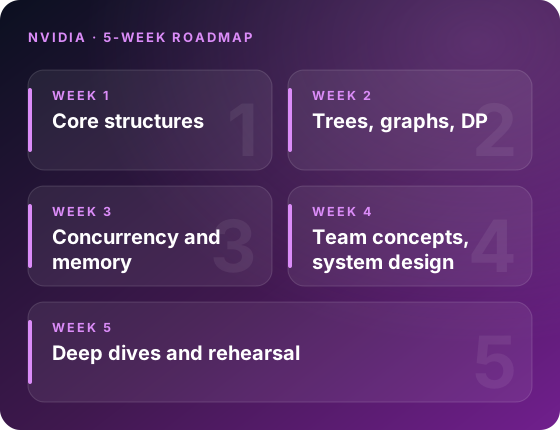
- Week 1. Core structures in Forge, written in the language you will use, with every cost stated.
- Week 2. Trees, graphs and sorting, then dynamic programming. Time every problem to 30 minutes.
- Week 3. Concurrency and memory: queues, pools, buffers and what happens under contention.
- Week 4. Your team's concepts, plus system design on scheduling, telemetry and serving, with two mocks.
- Week 5. Two project deep dives, questions for the team, and a rehearsal of five short interviews back to back.
The Interview plan tab in Revision builds a daily schedule from your weeks and hours, ticks off what you finish and brings your weak topics back through spaced revision. NVIDIA's plan is part of Pro.
Practice prompts
These are our own, written for practice. They are not questions anyone reports being asked.
- Implement a circular buffer for a stream of sensor readings and explain what happens when it is full.
- Implement a thread-safe queue with a size limit and say how consumers wait.
- Find a valid order in which to build software modules with dependencies, and say what you do about a cycle.
- Design a service that schedules jobs onto a shared pool of accelerators fairly.
- Design an inference service that batches requests to keep hardware busy.
- Tell me about making something noticeably faster and how you proved it.
Questions to ask your recruiter
- How many interviews will I have, and how long is each?
- Is there a coding exercise, and on which platform or tool?
- Which language is expected in the coding rounds?
- What does the team build, so I can refresh the right concepts?
- Is the in-person visit part of the loop or after it?
What we know and what we do not
NVIDIA's page confirms the stages, the interview lengths, the coding exercise and the rule on outside tools, and says nothing about counts or content. The rest is the shape accounts agree on, which differs widely by team and changes over time. We have not included any question a candidate says they were asked, and nothing here is a promise about what you will see. If your recruiter tells you something different, believe your recruiter. Last reviewed in October 2026.