
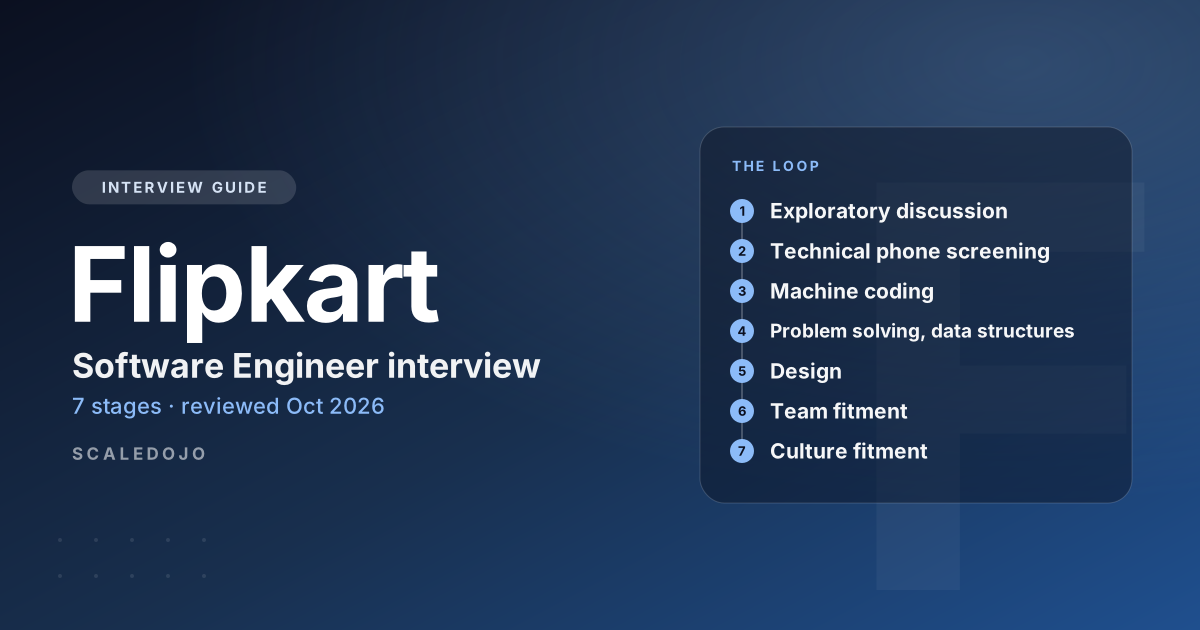
Flipkart publishes an interview guide for software engineers with every round, its length and what it assesses. The standout is the machine coding round: two hours to write working, well-structured code for a realistic problem and demonstrate it. This guide goes through the loop, round by round, with practice advice for each part.
How we put this together. The loop below comes from Flipkart's own documents: its interview-preparation guide for software development engineers, written for SDE-1 and SDE-2, and its How We Hire page. The advice on how to prepare is ours. Flipkart publishes separate guides for engineering managers and architects, and its processes can change, so confirm your loop with your recruiter.
The loop at a glance
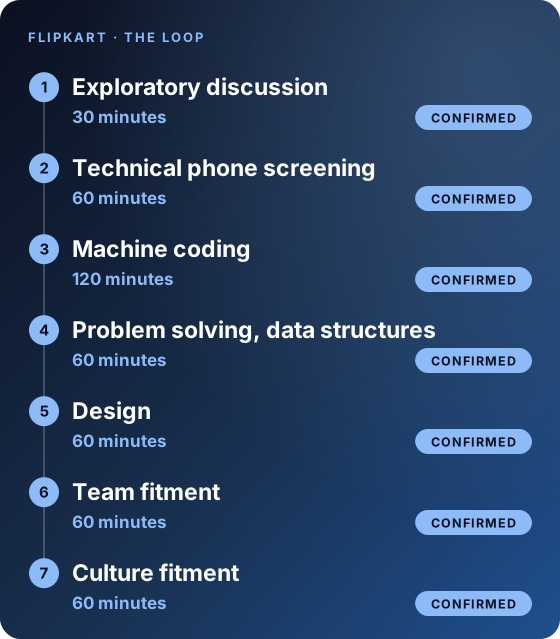
| Round | Length | What it covers | Where it comes from |
|---|---|---|---|
| Exploratory discussion | 30 minutes | A call with your potential hiring manager about your experience, expectations and aspirations. | SDE guide |
| Technical phone screening | 60 minutes | A discussion with a potential peer about past work, plus a few problem-solving questions. Not every candidate has one. | SDE guide |
| Machine coding | 120 minutes | Fifteen minutes to clarify, up to 90 to code, fifteen to demonstrate with the interviewer's test cases. | SDE guide |
| Problem solving and data structures | 60 minutes | One to three problems on common data structures and algorithms. | SDE guide |
| Design | 60 minutes | System design or object-oriented design on a non-trivial problem. | SDE guide |
| Team fitment | 60 minutes | Your hiring manager explores your aspirations, motivation and leadership. | SDE guide |
| Culture fitment | 60 minutes | Fit with Flipkart's four values. | SDE guide |
After the interviews, Flipkart says an independent hiring committee, with the interviewers and recruiters, takes a collective decision on your performance to keep decisions consistent. Its How We Hire page lists seven steps from application to onboarding.
What makes Flipkart different
- Machine coding is a full round. You write code that actually runs, on your laptop, then demonstrate it against the interviewer's test cases. Flipkart asks for functionally correct, modular, readable code that can take new requirements with minimal change.
- Design means two things. The design round can be system design or object-oriented design, and the guide names examples of each, so prepare both.
- Values get their own round. The culture fitment round assesses fit against four values: Audacity, Bias for Action, Customer First and Integrity.
- Honesty is invited. The guide says it is fine to admit past failures and that Flipkart places intent and commitment over success.
Round by round
Exploratory discussion and technical phone screening
The exploratory discussion is a 30-minute call with your potential hiring manager: introduce yourself, your work and your aspirations, and ask about the role's charter and scope. The 60-minute technical phone screening is with a potential peer, mainly about your past work, and the interviewer may go deep into one project. Know everything on your resume and have a short introduction ready.
Machine coding
A 120-minute round in three stages. In the 15-minute pre-coding stage the interviewer describes the problem and you ask questions to settle scope. In the coding stage, up to 90 minutes, you write executable code, with one or two checkpoints, and send it at the end. In the 15-minute post-coding stage you demonstrate it while the interviewer enters several test cases.
- Design before you code: decide the classes and their responsibilities, then write.
- Keep each class to one job and add a new rule without editing the old ones.
- Write your own test cases, including edge cases, and dry-run them before and after coding.
- Leave the last minutes for a working demo rather than another feature.
Practise on ScaleDojo: the LLD course, especially SOLID Principles, Creational Patterns, Structural Patterns, Behavioral Patterns and the case-study modules, then time yourself on a full 90-minute build.
Problem solving and data structures
Sixty minutes, one to three problems, usually on paper or a whiteboard. Flipkart lists the structures it expects you to know, array, linked list, stack, queue, hash map, tree, graph and heap, and the techniques: string manipulation, two pointers, searching, sorting, backtracking, bit manipulation and dynamic programming. It tests how you approach a problem, so think aloud and state the time and space cost.
Practise on ScaleDojo: Forge modules on Array & String Techniques, Hashing, Linked Lists, Heaps & Priority Queues, Sorting Algorithms, Backtracking, Trees & Binary Search Trees and 1D Dynamic Programming, with a pen and paper pass as well.
Design
A non-trivial problem, with no single expected answer. For system design, the guide's example is a social feed; for object-oriented design, a parking lot. Start by gathering requirements, which Flipkart calls the most important thing in the round, then discuss trade-offs and settle on a design. Know data stores and when to choose each, how distributed systems behave, the CAP theorem, scaling, caches and queues, and the basics of the internet and operating systems.
Practise on ScaleDojo: the HLD course, especially How the Web Actually Works, Databases 101, Caching for Speed, Consistency & Availability, Asynchronous Systems and the Capstone Case Studies, then mocks in the Mock Arena.
Team fitment and culture fitment
Team fitment is with your potential team leader, who explores your aspirations, motivations, self-awareness, leadership and stakeholder management; Flipkart describes it as a summary of the day. Culture fitment assesses your fit with Audacity, Bias for Action, Customer First and Integrity. Flipkart says there are no right or wrong answers, so prepare true examples for each value, including a failure.
How the loop differs by level
Flipkart's SDE guide covers SDE-1 and SDE-2 together, and describes them as engineers who build features from product requirements and learn design principles and non-functional concerns over time. Separate guides exist for engineering managers and architects. Our reading, not a Flipkart statement: expect the design round to carry more weight as you become more senior.
A six-week preparation plan
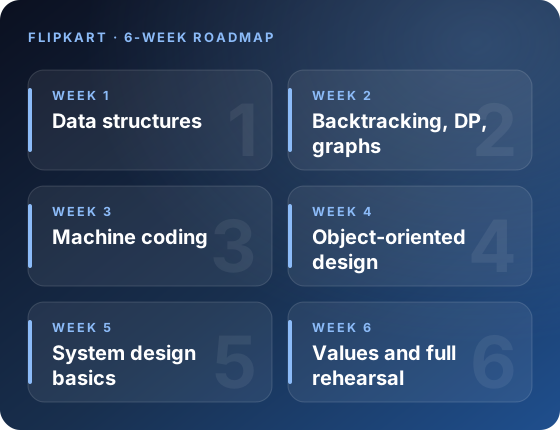
- Week 1. Data structures and techniques in Forge, solved on paper and then typed.
- Week 2. Backtracking, dynamic programming and graphs, plus a timed set of three problems.
- Week 3. Machine coding: pick four classic systems and build each in 90 minutes with a demo.
- Week 4. Object-oriented design: patterns and when to use them, in the LLD course.
- Week 5. System design basics and trade-offs, with two mocks.
- Week 6. Values stories for all four, then a full rehearsal of machine coding, problem solving and design in one day.
The Interview plan tab in Revision builds a daily schedule from your weeks and hours, ticks off what you finish and brings your weak topics back through spaced revision. Flipkart's plan is part of Pro.
Practice prompts
These are our own, written for practice. They are not questions anyone reports being asked.
- Code a parking lot with different vehicle sizes, a pricing rule and a way to add new rules.
- Code a food ordering service with restaurants, menus, carts and order status.
- Count the ways to make a given amount from a set of note denominations.
- Design an online sale where traffic jumps fifty times at midnight.
- Design the cart and checkout flow so stock is never oversold.
- Tell me about a bold idea you pushed even though others doubted it.
Questions to ask your recruiter
- Which rounds will I have, and on what day?
- Is there a technical phone screen for my role?
- Which language may I use in the machine coding round?
- Is the design round system design, object-oriented design, or both?
- Which guide applies to my level?
What we know and what we do not
Flipkart's guide and page confirm the rounds, their lengths and what each assesses for SDE-1 and SDE-2, and are undated. Flipkart's process can change, and other roles have their own guides, so check yours with your recruiter. We have not included any question a candidate says they were asked, and nothing here is a promise about what you will see. If your recruiter tells you something different, believe your recruiter. Last reviewed in October 2026.