
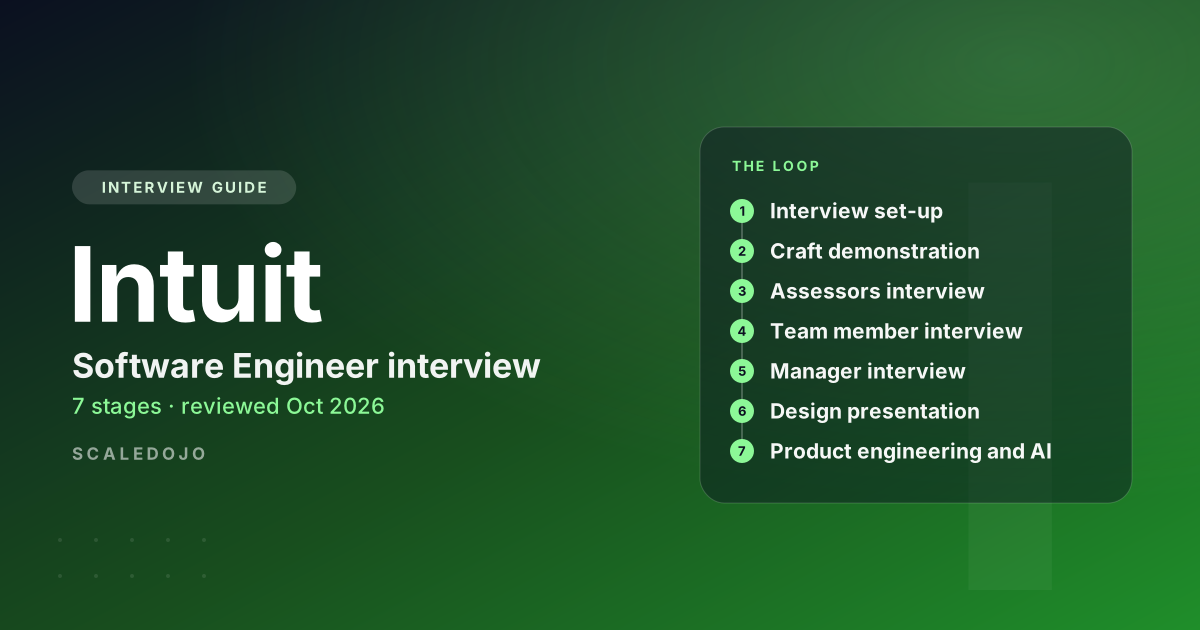
Intuit's interview has one feature worth preparing for early: you present. Rather than a string of one-on-one questions, the final round is built around a craft demonstration where you show your work and solve a problem in front of a small panel. Intuit publishes the stages and their lengths, and a 2025 post from its blog describes a design presentation and an AI proficiency session as well. This guide walks through each.
How we put this together. Intuit's hiring-process page gives the stages of the final interview, their lengths and a promise of feedback within 24 hours. A post on Intuit's blog from July 2025, built around one software engineer's experience, adds a design presentation and an AI proficiency session. The page does not split the process by level, so confirm which parts apply to you with your recruiter. The advice on preparation is ours.
The loop at a glance
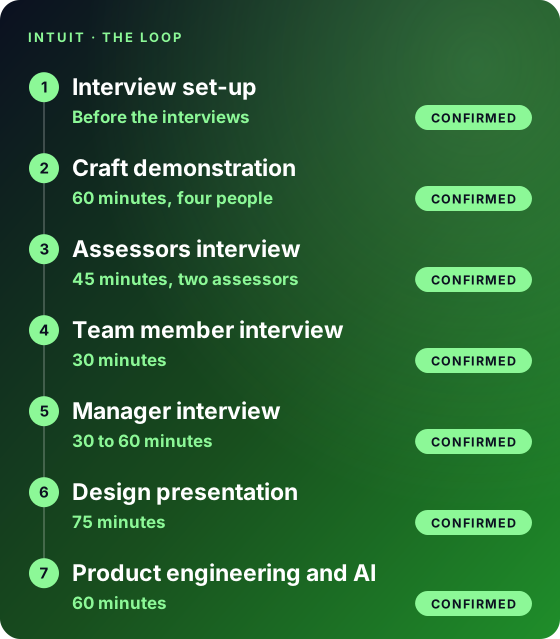
| Stage | Length | What happens | Where it comes from |
|---|---|---|---|
| Interview set-up | Before the interviews | Engineers download coding tools and solve a technical question to present. | Hiring page |
| Craft demonstration | 60 minutes, four people | You introduce yourself with visuals, discuss achievements and present a case study; engineers present their technical problem. | Hiring page |
| Assessors interview | 45 minutes, two assessors | Deep-dive questions on your skills, experience and the case study. | Hiring page |
| Team member interview | 30 minutes | A cross-functional colleague asks about Intuit values and the teams where you thrive. | Hiring page |
| Manager interview | 30 to 60 minutes | A people manager asks what motivates you and about your successes and lessons. | Hiring page |
| Design presentation | 75 minutes | A session focused on design and innovative concepts, with less coding. | Blog post |
| Product engineering and AI proficiency | 60 minutes | Half on design and product development, half on AI solutions in advanced products. | Blog post |
Intuit says it commits to giving you feedback within 24 hours of interviewing, and that you should contact its talent acquisition team if you hear nothing after a week.
What makes Intuit different
- You present, not just answer. The craft demonstration starts with a short introduction with visuals and a case study of your own work. Prepare slides or a visual you can walk through.
- Engineers solve a problem in advance. In the set-up period you download your tools and solve a technical question, and then present your solution and take questions on it.
- Design is a full session. The blog post describes a 75-minute design presentation that leans toward ideas and strategy rather than code.
- AI is assessed. The post describes a session on AI solutions and how they fit into advanced products, next to coding proficiency, logical reasoning, collaboration and adaptability.
Round by round
Interview set-up and the craft demonstration
Use the set-up time to install your tools, open your editor and solve the technical question calmly. Then, in the 60-minute demonstration with four people from the hiring team, introduce yourself briefly with visuals, discuss your achievements and present a case study that shows how you solve problems. Intuit's post describes an algorithm problem, with a panel asking probing follow-ups on the solution and how it applies in practice.
- Keep your introduction to a couple of minutes and your case study to one problem, one decision and one result.
- For the algorithm problem, explain your approach before the code and your cost after it.
- Expect cross-questioning: why this structure, what if the input were ten times larger.
Practise on ScaleDojo: Forge modules on Array & String Techniques, Hashing, Heaps & Priority Queues, Sorting Algorithms and 1D Dynamic Programming, and rehearse presenting each solution aloud.
Assessors, team member and manager interviews
The assessors interview is 45 minutes with two people who dig into your skills and your case study. The team member interview is 30 minutes with a cross-functional colleague, usually about Intuit values and the environments where you thrive. The manager interview is 30 to 60 minutes about motivation, experience, successes and lessons. Intuit's blog names customer obsession and an entrepreneurial mindset, so have a true story for each.
Design presentation
As the blog post describes it, this is a 75-minute session on design and innovative concepts rather than coding. Treat it as a short product architecture talk: the customer problem, the shape of the system, the two hardest trade-offs and how you would know it works. Intuit's products suggest useful practice: tax filing with a seasonal peak, bank account linking, invoicing and secure handling of sensitive data. That is our suggestion, not a list of questions.
Practise on ScaleDojo: the HLD course on Databases 101, Protecting Your System, Distributed Transactions & Resilience and the Capstone Case Studies, the API Design course on correctness, and mocks in the Mock Arena.
Product engineering and AI proficiency
The post describes a 60-minute session in two halves: design considerations and your approach to developing a product, then AI solutions and how they fit into advanced products. Be ready to talk about where an AI feature helps customers, how you would check its answers, what guardrails it needs and how you would measure it.
Practise on ScaleDojo: the GenAI course, especially Building the RAG Pipeline, Guardrails, Cost & Observability and Evaluation, Generalization & Failure Modes.
How the loop differs by level
Intuit's hiring page does not split the process by level, and the blog post follows one engineer's loop. Our reading, not an Intuit statement: the design presentation and AI session carry more weight for experienced engineers, while the craft demonstration matters at every level. Ask your recruiter which sessions are in your loop.
A five-week preparation plan
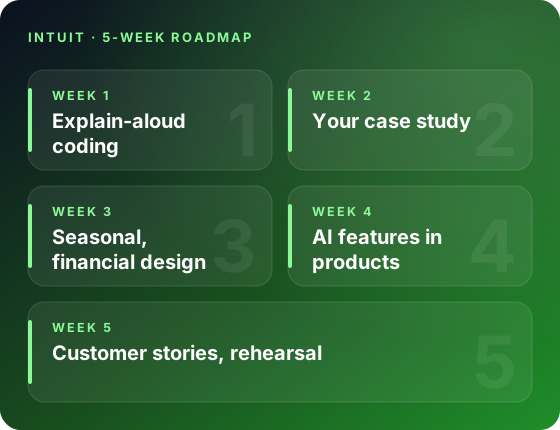
- Week 1. Forge problems, each explained aloud as if to a panel of four.
- Week 2. Your case study: choose one project and build a short visual walk-through with one problem, one decision and one result.
- Week 3. Design practice: seasonal load, financial data, linking accounts, with two mocks.
- Week 4. AI features in products: retrieval, guardrails, evaluation, and how to measure customer benefit.
- Week 5. Stories for customer obsession and an entrepreneurial mindset, then a full rehearsal with a timer.
The Interview plan tab in Revision builds a daily schedule from your weeks and hours, ticks off what you finish and brings your weak topics back through spaced revision. Intuit's plan is part of Pro.
Practice prompts
These are our own, written for practice. They are not questions anyone reports being asked.
- Compute income tax from a table of brackets for a given income.
- Reconcile a bank statement with a list of ledger entries and report what differs.
- Design a tax filing service that handles most of its traffic in a few weeks.
- Design checks that stop a generated answer from giving wrong tax advice.
- Design the API to link a bank account with the customer's consent and the right to revoke it.
- Walk me through a case study of your work as you would present it.
Questions to ask your recruiter
- Which sessions are in my final interview, and how long is each?
- What should I prepare for the craft demonstration and the case study?
- Is there a design presentation or an AI proficiency session for my role?
- Which tools should I set up during the interview set-up time?
- Who will be in the room for each session?
What we know and what we do not
Intuit's page confirms the stages of the final interview and their lengths, and its blog post describes a design presentation and an AI session for one engineer. The post may not match every role, so check your loop with your recruiter. We have not included any question a candidate says they were asked, and nothing here is a promise about what you will see. If your recruiter tells you something different, believe your recruiter. Last reviewed in October 2026.