Most company guides can say 'the loop has five rounds'. For an Apple software engineer interview, that is not true, and that is the most useful thing to know going in. Accounts agree that there is no single process: the hiring team shapes its own, so the questions, the number of rounds and even whether there is a take-home differ from team to team. This guide is therefore less a round-by-round script and more a method for finding out what your team does and preparing for it.
How we put this together. Apple's own careers pages cover accommodations during hiring and say your recruiter supports you; they do not describe the interview stages. The shape below is what several public candidate accounts agree on, read in October 2026. Apple has not confirmed it. Treat everything here as a starting point and confirm it with your recruiter.
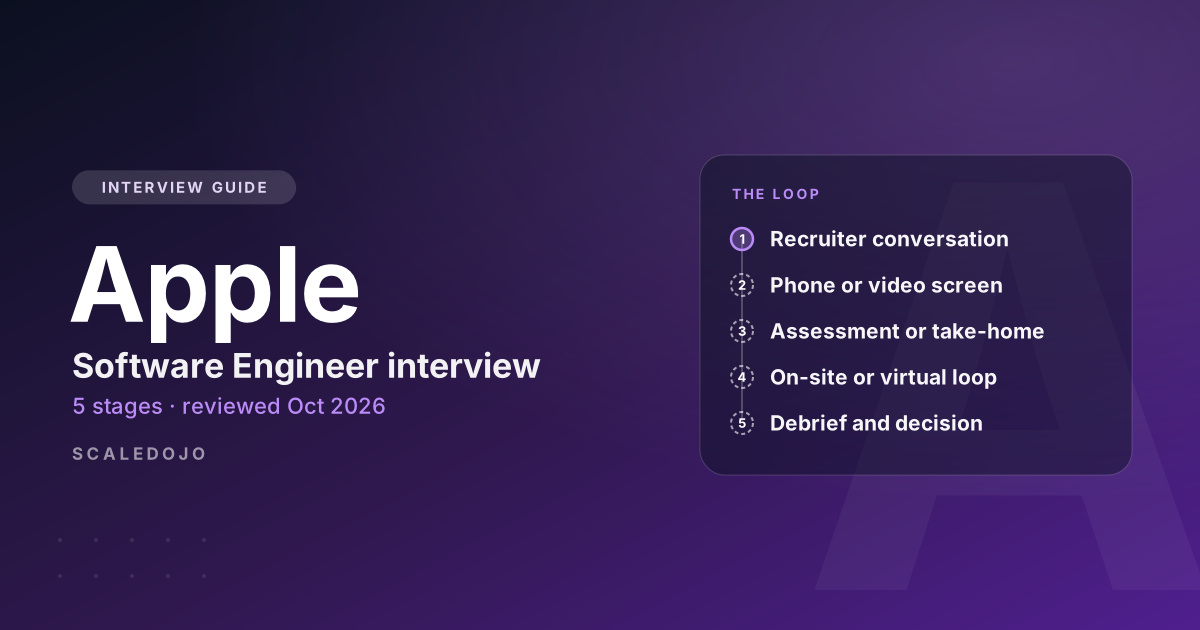
The usual shape
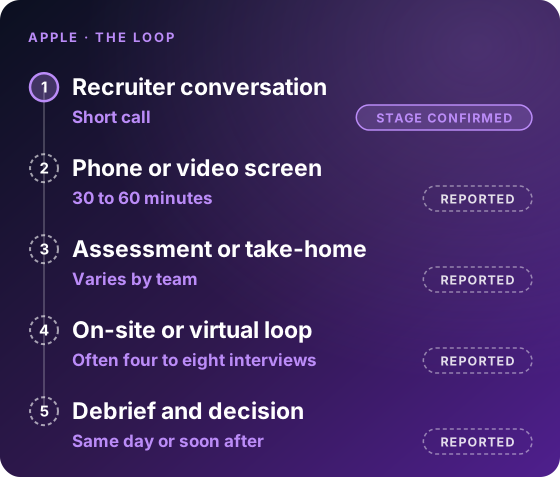
| Stage | Typical length | What happens | How sure are we |
|---|---|---|---|
| Recruiter conversation | Short call | Your background and the team you may join. Recruiters are matched to teams, so they often know the style that team prefers. | Apple confirms recruiter support; the rest is reported |
| Phone or video screen | 30 to 60 minutes | Usually coding in a shared editor, or a conversation about your work, depending on the team. | Reported |
| Optional assessment or take-home | Varies | Some teams add an online assessment or a practical task in the team's own technologies. | Reported; team-dependent |
| On-site or virtual loop | Often four to eight interviews | Back-to-back sessions with future teammates, one or two interviewers at a time. | Reported; the count varies widely |
| Debrief and decision | Same day or soon after | Interviewers compare notes with the hiring manager, whose view carries a lot of weight. | Reported |
What makes Apple different
- The team writes the interview. Interviewers reportedly pick their own questions, so a firmware team, a cloud services team and a client team can ask for very different things.
- Domain fit matters. The questions often follow what the team does every day, which means your relevant experience is part of the interview, not only your problem solving.
- Motivation is examined. Accounts say interviewers care why you want to work at Apple and on that product, and they notice a generic answer.
- The hiring manager has a strong voice. Decisions are described as made in a debrief where the hiring manager's view weighs heavily, which makes one strong advocate valuable.
Step one: decode your team
Before you prepare anything, work out what kind of team it is, because that sets the mix. This table is our reading, not an Apple statement. Use it to choose where to spend your hours, then check it with your recruiter.
| If the team builds | Expect more of | Spend your hours on |
|---|---|---|
| Client apps and frameworks | Practical coding, object design, performance, debugging | Forge arrays, strings, hashing; the LLD course; concurrency basics |
| Cloud services and backends | System design, data modelling, reliability | The HLD course; Databases 101, Caching for Speed, Consistency & Availability; API design |
| Platform, systems or infrastructure | Concurrency, memory, performance, deep CS fundamentals | Forge Measuring Code, sorting, trees and graphs; Concurrency for LLD |
| Machine learning or data products | Coding plus applied design for data pipelines and models | Forge fundamentals; HLD storage and asynchronous modules; the GenAI course |
Round by round
Recruiter conversation
Treat this as your best source of information. Recruiters are reported to be matched to teams, so ask them what the loop for this team looks like, how many interviews it has, whether there is a take-home, and what the team builds day to day. Form a good relationship early: they are the person who knows the style.
Phone or video screen
Often a coding session of 30 to 60 minutes in a shared editor, with data structures, algorithms and a discussion of complexity. For some roles it is a conversation about your work instead. Practise both: solve a medium problem aloud, and explain a past project in five minutes without notes.
Practise on ScaleDojo: Forge problems on Hashing, Stacks & Queues, Trees & Binary Search Trees and Measuring Code, with a habit of stating complexity every time.
Take-home or assessment
If your team uses one, it is a practical problem in the team's own technologies. Write it as you would for a code review: small functions, clear names, tests, and a short note on what you would do with more time. Respect the time limit you are given.
The loop
Several interviews, usually with the people you would work with. A mix of coding, design and conversation about your experience is typical, but the weighting follows the team. One account says coding counts for less and design for more at senior levels, but treat that as one data point. Come with questions about the team's work; interested candidates stand out.
- Coding: practical and rigorous. Reports describe both everyday engineering problems and classic algorithm questions. Think aloud and test your own code.
- Design: reliability is a recurring theme in accounts. Prepare to say how your design fails and how it recovers.
- Experience conversations: know your own projects deeply, including what you would redo.
Practise on ScaleDojo: the HLD course capstones, the LLD course and time-boxed mocks in the Mock Arena.
Why Apple
Write a real answer. Which product do you use closely, what would you change about it, what part of building it would you like to own? Specific beats polished. Do not recite marketing; show that you have thought about the craft.
How the loop differs by level
Apple publishes nothing on this, and accounts disagree. Our reading, not an Apple statement: early-career loops lean on coding fundamentals, while senior loops give more room to design and to the decisions behind your past work. The team and the hiring manager matter more than the level label.
A four-week preparation plan
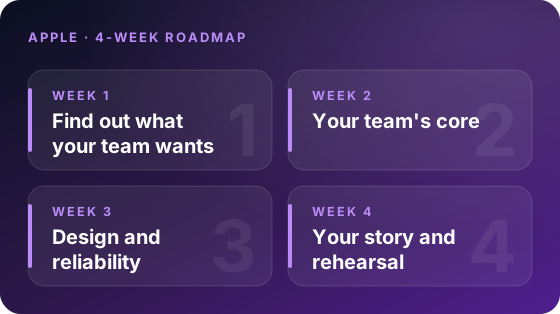
- Week 1, find out. Ask your recruiter the questions below. Decide which row of the team table you are in. Start Forge fundamentals.
- Week 2, your team's core. Spend most of the week on what that team will ask for: coding, object design or systems.
- Week 3, design and reliability. Two design walk-throughs with failure modes spelled out, and one timed mock.
- Week 4, you. Prepare your why-Apple answer, two project deep dives, questions for the team, and one full rehearsal.
The Interview plan tab in Revision can build the daily schedule from your weeks and hours. Apple's plan is a general product-company shape, because Apple does not publish its stages, so adjust it with what your recruiter tells you. It is part of Pro.
Practice prompts
These are our own, written for practice. They are not questions anyone reports being asked.
- Design the sync layer so a user's notes appear on all their devices, including after one has been offline for a week.
- Design photo backup that copes with a slow connection and never uploads the same photo twice.
- Implement a thread-safe ring buffer for a stream of sensor readings, and explain how you would test it.
- An app uses more battery after an update. Describe how you would find out why.
- Describe a product you admire and one decision in it you would change, with your reasoning.
- Design how a server delivers a notification to a phone that may be asleep or offline.
- Tell me about something you shipped that you are proud of, and one thing about it that still bothers you.
Questions to ask your recruiter
- What does the loop for this team look like, and how many interviews does it have?
- Is there an online assessment or take-home, and how long is it?
- What does the team build day to day, and which technologies should I refresh?
- Is the coding practical, algorithmic or both?
- How is design weighted for my level?
What we know and what we do not
Apple has not published its engineering interview stages, accounts vary a great deal between teams, and the details change. We have not included any question a candidate says they were asked, and nothing here is a promise about what you will see. If your recruiter tells you something different, believe your recruiter. Last reviewed in October 2026.