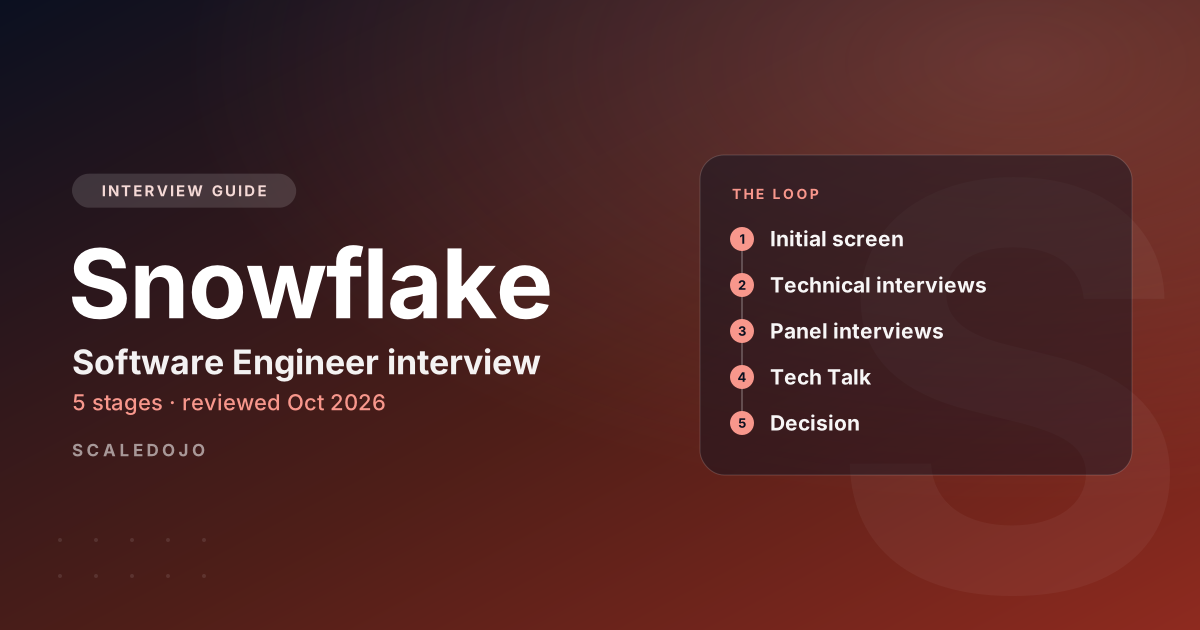
The Snowflake software engineer interview follows a process the company lays out clearly: four stages, a stated length for most of them, and a panel round that may include a presentation. What the page does not say is what the questions are like. Candidates are consistent about that part: they lean toward databases and data systems. This guide covers both.
How we put this together. Snowflake's hiring process page for engineering gives the four stages, the lengths, the panel and the Tech Talk. It says roles and teams may add steps and that at least one in-person office interview may be required. The detail about the questions is the shape several public candidate accounts agree on, read in October 2026. Snowflake has not confirmed it, and teams differ.
The loop at a glance
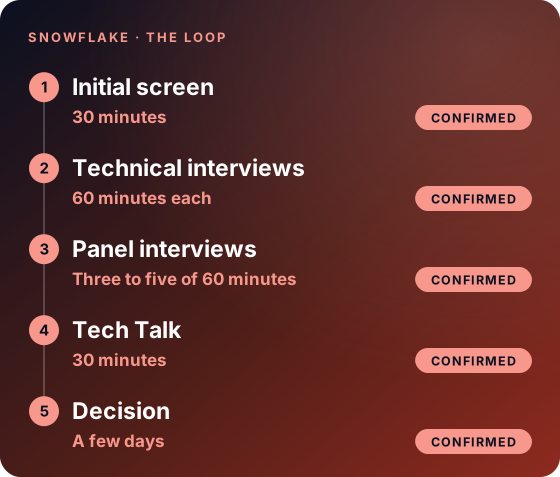
The Snowflake loop as Snowflake publishes it. Lengths and order can change, so confirm yours with your recruiter.
Stage | Typical length | What happens | How sure are we |
|---|---|---|---|
Initial screen | 30 minutes | A call with a recruiter and/or the hiring manager about your skills and the role. | Snowflake confirms it |
Technical interviews | 60 minutes each | Coding and/or system design, with live coding questions. | Snowflake confirms it |
Panel interviews | Three to five of 60 minutes | Technical, expertise, system design, behavioural and collaboration interviews with several team members. | Snowflake confirms it |
Tech Talk | 30 minutes | A presentation, included depending on the level and role. | Snowflake confirms it |
Decision | A few days | The team debriefs and decides; reference and background checks follow. | Snowflake confirms it |
Coding content | Within the rounds | Problems about data structures inside databases, query optimisation and workloads. | Reported |
Snowflake says the process takes up to two to four weeks. It also mentions guidance on the use of AI in interviews on its careers pages, so read it before you start and follow it.
What makes Snowflake different
The panel is a mix. Snowflake lists technical, expertise, system design, behavioural and collaboration interviews, so you cannot prepare for one kind of question.
There may be a presentation. A 30-minute Tech Talk may be part of the loop depending on level and role. Treat it as a round in its own right.
Questions often follow the business. This is what candidates describe rather than something Snowflake states: coding and design problems about databases, query optimisation, data storage and data movement.
The team may differ. Accounts say the coding and design questions are often specific to the team and not standard puzzle questions.
Round by round
Initial screen
Thirty minutes with a recruiter and/or the hiring manager, who want to get to know you and your technical skills. Snowflake suggests asking questions about the role. Prepare a two-minute account of what you have built and ask what the team works on.
Technical interviews
Sixty minutes each, covering coding and/or system design with live coding questions. Accounts say problems start at easy to medium and can deepen into hard, and that many are about the data structures inside databases and how to optimise for a workload. Get comfortable explaining why an index, a cache or a sort order helps.
State assumptions about data size before choosing a structure.
Say what changes if the data does not fit in memory.
Test with an empty input and with a duplicated key.
Practise on ScaleDojo: Forge modules on Hashing, Heaps & Priority Queues, Sorting Algorithms, Trees & Binary Search Trees and Algorithms Behind Caching, then the LLD course on Case Studies: Data-Structure-Heavy Systems.
Panel interviews
Three to five sessions of an hour with different team members. Expect a system design, an expertise interview about your own projects, a behavioural interview and a collaboration interview. For the expertise discussion, accounts say interviewers ask for the reasoning behind every design decision, so pick projects you can defend in depth.
Practise on ScaleDojo: the HLD course, especially Databases 101, Unique IDs & Distributing Data, Consistency & Availability, Storage at Scale and Distributed Transactions & Resilience, then mocks in the Mock Arena.
Tech Talk
If your loop includes one, you present a project for about 30 minutes. Choose a project where you made real decisions, say the problem first, show one diagram, explain two trade-offs, give the result with a number, and leave time for questions. Rehearse it aloud with a timer.
Decision
The team debriefs within a few days and decides. Snowflake notes that reference and background checks follow, and that if you have not heard within 30 days of applying, you probably did not meet the requirements.
How the loop differs by level
Snowflake's page does not name levels, except that the Tech Talk depends on level and role. Our reading, not a Snowflake statement: earlier-career candidates should expect more coding, and experienced candidates more system design and the expertise discussion. Ask your recruiter whether a Tech Talk applies to you.
A five-week preparation plan
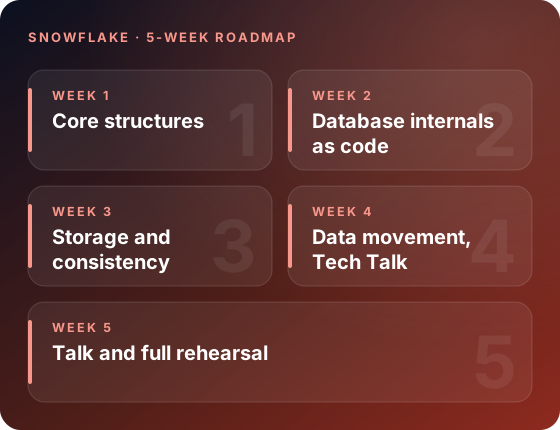
A 5-week order of preparation for the Snowflake loop. Stretch it or squeeze it to the time you have.
Week 1. Core structures in Forge, with the data-size question asked every time.
Week 2. Database internals as coding: indexes, buffer caches, merges and joins.
Week 3. Storage and consistency in the HLD course, then your first design mock.
Week 4. Data movement and multi-tenant design, with two mocks. Pick the project for your Tech Talk and outline it.
Week 5. Rehearse the talk aloud, defend two past decisions in depth, and run a full rehearsal.
The Interview plan tab in Revision builds a daily schedule from your weeks and hours, ticks off what you finish and brings your weak topics back through spaced revision. Snowflake's plan is part of Pro.
Practice prompts
These are our own, written for practice. They are not questions anyone reports being asked.
Implement an in-memory index that supports insert, lookup and range queries over sorted keys.
Choose the order in which to join several tables to keep intermediate results small.
Design a cloud data warehouse where storage and compute scale separately.
Design time travel, so a user can query a table as it was last week.
Design workload isolation so one customer's heavy query cannot slow others.
How would you structure a 30-minute talk on your best project?
Questions to ask your recruiter
Which interviews are in my panel, and in which order?
Is a Tech Talk part of my loop, and what should it cover?
Will any interview be in person?
Is the coding in my own editor or a shared one?
What is the guidance on using AI during interviews?
What we know and what we do not
Snowflake's page confirms the stages, the lengths, the panel and the Tech Talk, and says roles and teams may add steps. The content of the questions is the shape accounts agree on, which differs by team and changes over time. We have not included any question a candidate says they were asked, and nothing here is a promise about what you will see. If your recruiter tells you something different, believe your recruiter. Last reviewed in October 2026.