Walmart Global Tech builds the systems behind one of the largest retail operations in the world: inventory across thousands of stores, online orders, delivery, pricing and supply chain. Its public material tells you how to apply but not what the engineering interviews contain, so this guide is mostly about what candidates describe, with that fact stated up front.
How we put this together. Walmart's hiring process page says the application takes about 20 to 25 minutes, that some roles require an assessment, and that you are told if you are not selected for an interview. It describes no interview rounds. Everything about the rounds below is the shape several public candidate accounts agree on, read in October 2026. Walmart has not confirmed it, and accounts differ by level and team, so treat it as a starting point.
The loop at a glance
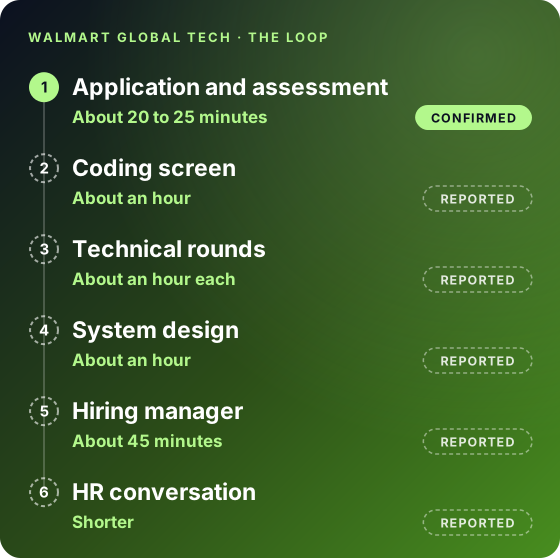
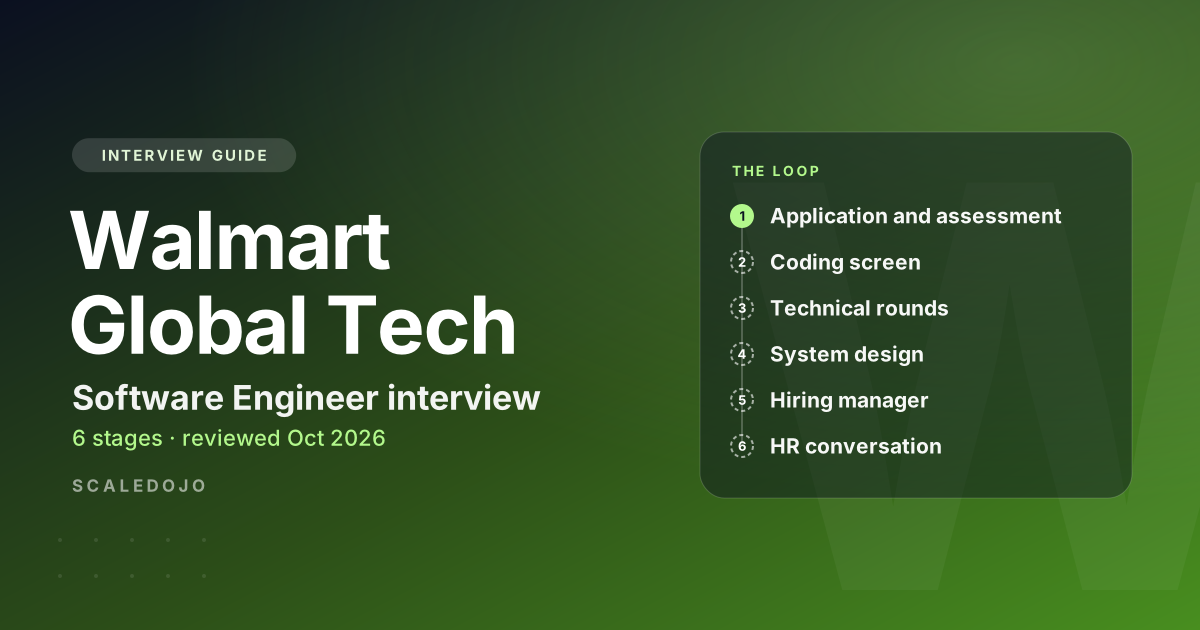
The Walmart Global Tech loop. Solid markers are confirmed by Walmart Global Tech. Dashed markers are reported by candidates. Confirm your own schedule with your recruiter.
Stage | Typical length | What happens | How sure are we |
|---|---|---|---|
Application and assessment | About 20 to 25 minutes, plus any assessment | Online application; some roles add an assessment. | Walmart confirms it |
Coding screen | About an hour | A first technical screen with coding problems, in some accounts run by an outside interviewing service. | Reported |
Technical rounds | About an hour each | Data structures and algorithms, a technical discussion that can include object-oriented design, and Java and database topics. | Reported |
System design | About an hour | A high-level design round at mid and senior levels; some roles also have a deeper software design round. | Reported |
Hiring manager | About 45 minutes | Your experience, how you work and the team's work. | Reported |
HR conversation | Shorter | Fit and logistics. | Reported |
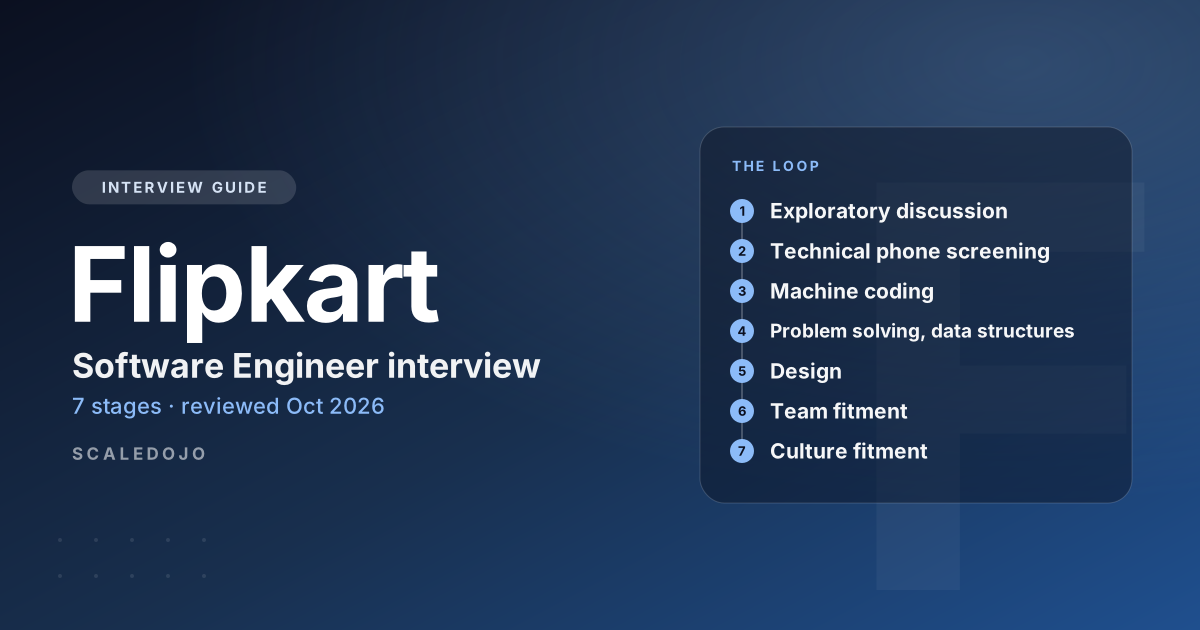
Accounts describe about four interview rounds after the screen. At some levels all the technical rounds are coding; at others there are two coding rounds and one system design. Ask your recruiter for your actual schedule.
What makes Walmart Global Tech different
The business is retail at scale. This is our reading rather than a Walmart statement: engineers deal with inventory accuracy, store and online orders, prices and supply chains, so design problems tend to draw on those.
The stack is often Java. Accounts mention Java, Spring, relational and NoSQL databases and messaging, and job descriptions commonly ask for solid data-structure fundamentals and experience with REST APIs and microservices.
Levels differ. Reports describe more coding rounds at lower levels and a design round at higher ones.
Walmart's own page is thin. Only the application is documented, so confirm everything else with your recruiter.
Round by round
Application and assessment
Walmart says a resume is not required but your job history is, and that some positions need an assessment on top. It also offers interactive job simulations that let you try parts of a role before you apply. If you are not selected for an interview, Walmart says you will be told.
Coding screen
Accounts describe a first screen with one or two coding problems on common data structures and algorithms, in some cases run through an outside interviewing service. Treat it as a gate: be fluent on arrays, strings, hash maps, trees and graphs, and practise writing clean code against a clock.
Practise on ScaleDojo: Forge modules on Array & String Techniques, Hashing, Linked Lists, Stacks & Queues, Heaps & Priority Queues, Trees & Binary Search Trees and Graph Fundamentals.
Technical rounds
Accounts describe a round on data structures and algorithms, and another that goes deeper into a technical area: object-oriented design, Java concepts, databases or the details of a past project. Prepare to design a small system in classes, to explain how you would model data, and to discuss concurrency and error handling.
Practise on ScaleDojo: the LLD course on OOP Foundations & UML, SOLID Principles, Creational Patterns and Case Studies: Marketplace & Booking Systems, plus Relational Modeling Foundations.
System design
At mid and senior levels, accounts describe a high-level design round on components, data stores and trade-offs. Walmart's business suggests useful practice: inventory across stores, omnichannel orders, pickup slots, pricing and supply chain. That is our suggestion, not a list of questions.
Practise on ScaleDojo: the HLD course, especially Databases 101, Caching for Speed, Asynchronous Systems, Distributed Transactions & Resilience, Microservices & Service Architecture and the Capstone Case Studies, then mocks in the Mock Arena.
Hiring manager and HR conversations
The hiring manager round is about your experience, your way of working and the team's work. Bring two projects you can explain in depth and be ready to say how you handled a production problem. The HR conversation covers fit and logistics.
How the loop differs by level
Walmart's page does not name levels, and accounts disagree. The pattern most often described: earlier levels face three coding-style technical rounds, while senior levels face two coding rounds and a system design round. Our reading, not a Walmart statement: the more senior the role, the more the loop is design and discussion. Ask your recruiter how your level is weighted.
A five-week preparation plan
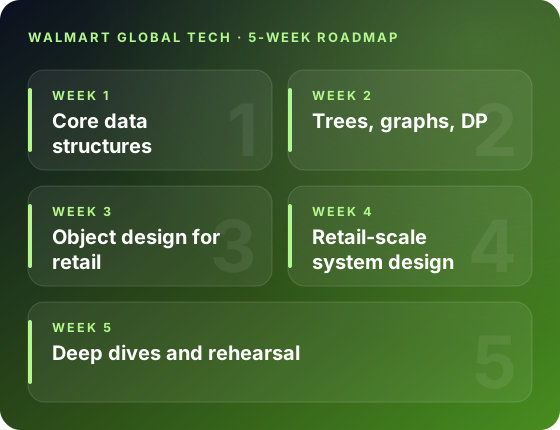
A 5-week order of preparation for the Walmart Global Tech loop. Stretch it or squeeze it to the time you have.
Week 1. Core data structures in Forge, timed, in the language you will use.
Week 2. Trees, graphs, dynamic programming and a timed set of three problems.
Week 3. Object design for carts, promotions, inventory and orders in the LLD course.
Week 4. System design for inventory and orders at retail scale, with two mocks.
Week 5. Two project deep dives, a production-incident story, and a full rehearsal.
The Interview plan tab in Revision builds a daily schedule from your weeks and hours, ticks off what you finish and brings your weak topics back through spaced revision. Walmart Global Tech's plan is part of Pro.
Practice prompts
These are our own, written for practice. They are not questions anyone reports being asked.
Allocate stock from several stores to meet demand while moving as few items as possible.
Find the k most frequently searched items in the last day from a stream.
Design inventory accuracy across thousands of stores and warehouses in near real time.
Design order management for online, store pickup and home delivery with one stock count.
Design the order API so a double tap never places two orders.
Tell me about a production mistake and what you did in the first hour.
Questions to ask your recruiter
Which rounds will I have, and how long is each?
Is there an assessment or an outside coding screen first?
Is there a system design round at my level?
Which language is expected in the coding rounds?
Who will interview me, and is the hiring manager part of the loop?
What we know and what we do not
Walmart's hiring page documents the application and assessment steps and describes no interview rounds. Everything else here is the shape accounts agree on, which differs by level and team and changes over time. We have not included any question a candidate says they were asked, and nothing here is a promise about what you will see. If your recruiter tells you something different, believe your recruiter. Last reviewed in October 2026.