If you're prepping for a Databricks software engineer interview, it helps to know the company is changing how it evaluates candidates: away from pure algorithm recall and toward hands-on work on design, code structure, debugging and learning something new. That is worth knowing before you start, because it changes how you should practise. This guide covers what Databricks says, what candidates describe, and how to prepare.
How we put this together. Databricks' own interview-preparation page gives the stages, the loop of four to six interviews, the 45 to 90 minute length and what is assessed. A Databricks engineering post from January 2020 adds what engineering interviews evaluate and common mistakes. The technical detail is the shape several public candidate accounts agree on, read in October 2026. Databricks has not confirmed it, and teams differ.
The loop at a glance
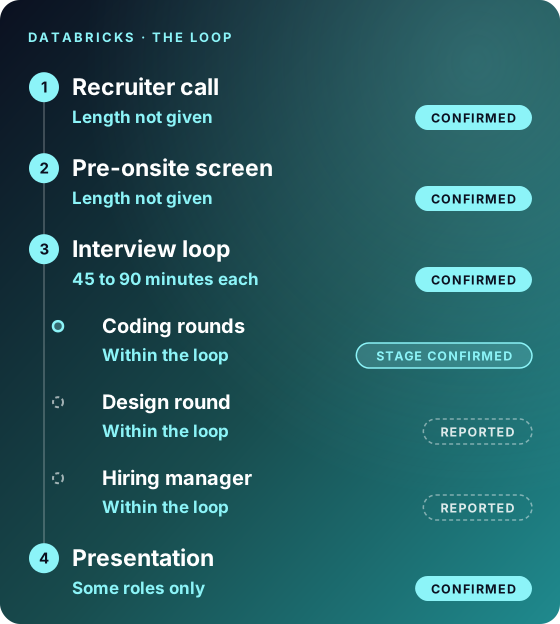
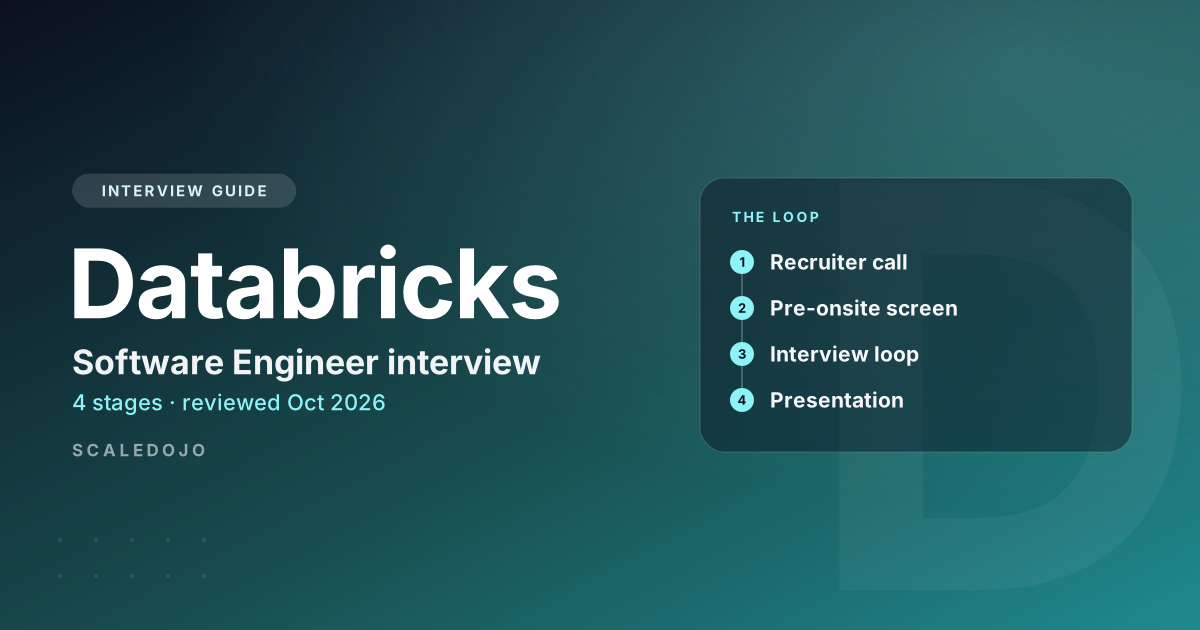
The Databricks loop. Solid markers are confirmed by Databricks. Tinted markers are stages Databricks names, with the detail from candidates. Dashed markers are reported by candidates. Confirm your own schedule with your recruiter.
Stage | Typical length | What happens | How sure are we |
|---|---|---|---|
Recruiter call | Not given | An initial conversation about your background and interest. | Databricks confirms it |
Pre-onsite screen | Not given | A hiring manager screen, a technical assessment or a skills evaluation. | Databricks confirms it |
Interview loop | 45 to 90 minutes each | Four to six interviews with team members, virtual by default. | Databricks confirms it |
Coding rounds | Within the loop | Working code, some on concurrency and some on design patterns such as retries. | Databricks describes hands-on coding; the topics are reported |
Design round | Within the loop | A high-level design with deep dives, sometimes building a small storage system in steps. | Reported |
Hiring manager | Within the loop | Your experience and how you would work on the team. | Reported |
Presentation | Some roles | Required for some roles, particularly go-to-market and executive ones. | Databricks confirms it |
Databricks says the whole process usually takes two to three months and that it aims to share feedback within 48 hours of the final interview. Interviews are on Google Meet by default.
What makes Databricks different
Hands-on over recall. Databricks says the focus is less on algorithm knowledge and more on design, code structure, debugging and learning new domains. You can work on a laptop instead of a whiteboard.
Unfamiliar territory is deliberate. Some questions use a language or framework you do not know, to see whether you can read documentation and solve a problem in a new area.
Feature work grows in stages. Its engineering post describes implementing a feature step by step across stages, so leave room in your code for the next requirement.
Fundamentals still count. The same post lists data structures, runtime and memory, plus multi-threading and operating-system ideas for systems roles and web basics such as HTTP, WebSockets and authentication for full-stack roles.
Round by round
Recruiter call and pre-onsite screen
The recruiter call covers your background and interest, so know the product and say what you have tried. The pre-onsite screen depends on the role: a hiring manager conversation, a technical assessment or a skills evaluation. Ask which it is for you.
Coding rounds
Accounts describe working code under time pressure, some of it on concurrency and some on design patterns such as retries and idempotency, with a technical screen of about an hour. Databricks' advice is to practise complete solutions with tests, not fragments.
Write a small test first so you know when you are done.
When you hit an unfamiliar API, read its documentation aloud as you go.
If an approach is not working, say so and switch rather than patch it for twenty minutes. Databricks lists fixation on a failing approach as a common mistake.
Practise on ScaleDojo: Forge modules on Measuring Code, Hashing, Heaps & Priority Queues and Algorithms Behind Distributed Systems, plus the LLD course on Concurrency for LLD and Case Studies: Data-Structure-Heavy Systems.
Design round
Accounts describe a high-level design with deep dives into parts of it, and sometimes a build-it-yourself exercise, such as a small storage system that starts on one thread, then handles several threads, then several machines. The skill is moving between levels: boxes and arrows when asked for the big picture, data structures and failure handling when asked to go deep.
Practise on ScaleDojo: the HLD course, especially Databases 101, Unique IDs & Distributing Data, Consistency & Availability, Asynchronous Systems, Storage at Scale and Distributed Transactions & Resilience, then mocks in the Mock Arena.
Hiring manager and behavioural interviews
Databricks says behavioural interviews ask for real-life examples of how you work, learn, collaborate and handle challenges, and its engineering post describes the engineers it wants: ownership beyond the assigned team, a strong ability to learn, and breadth across neighbouring systems. Prepare specific stories; Databricks lists vague answers and low enthusiasm among common mistakes.
Presentation
Required for some roles, particularly go-to-market and executive ones, so most engineers will not have one. For some roles, accounts also mention a case study or design document that you present to a panel; ask whether yours does.
How the loop differs by level
Databricks' pages do not split the process by level. Our reading, not a Databricks statement: earlier-career candidates should expect more coding, and experienced candidates more design, breadth and discussion of ownership. Ask your recruiter how your level is weighted.
A six-week preparation plan
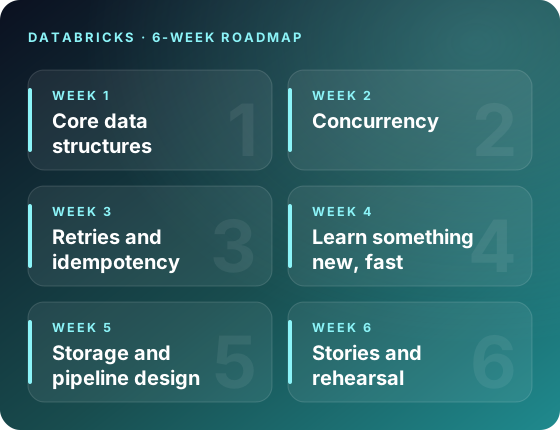
A 6-week order of preparation for the Databricks loop. Stretch it or squeeze it to the time you have.
Week 1. Core data structures in Forge, every solution with a test.
Week 2. Concurrency: queues, locks, thread pools and what breaks under contention.
Week 3. Retries, idempotency and failure handling in code, then in the API Design course.
Week 4. Learn something new on a deadline: pick an unfamiliar library and solve a small task from its documentation.
Week 5. System design on storage, pipelines and schedulers, with three mocks.
Week 6. Specific stories for ownership, learning and breadth, and a full rehearsal.
The Interview plan tab in Revision builds a daily schedule from your weeks and hours, ticks off what you finish and brings your weak topics back through spaced revision. Databricks's plan is part of Pro.
Practice prompts
These are our own, written for practice. They are not questions anyone reports being asked.
Implement a bounded blocking queue that several producers and consumers share.
Implement retries with exponential backoff and jitter for a flaky call, and make the operation safe to repeat.
Implement a key-value store with a write-ahead log, then make it safe for several threads.
Design ACID tables on top of cheap object storage.
Design a scheduler for data pipelines with dependencies, retries and backfills.
Tell me about taking ownership of something outside your team's scope.
Questions to ask your recruiter
What is the pre-onsite screen for my role?
How many interviews are in the loop, and how long is each?
May I use my own laptop and editor, and which languages are allowed?
Will any question use a language or framework I may not know?
Is there a presentation or case study for my role?
What we know and what we do not
Databricks' pages confirm the stages, the length and format of the loop and what it assesses. Its engineering post dates from 2020, and the technical topics are the shape accounts agree on, which differs by team and changes over time. We have not included any question a candidate says they were asked, and nothing here is a promise about what you will see. If your recruiter tells you something different, believe your recruiter. Last reviewed in October 2026.