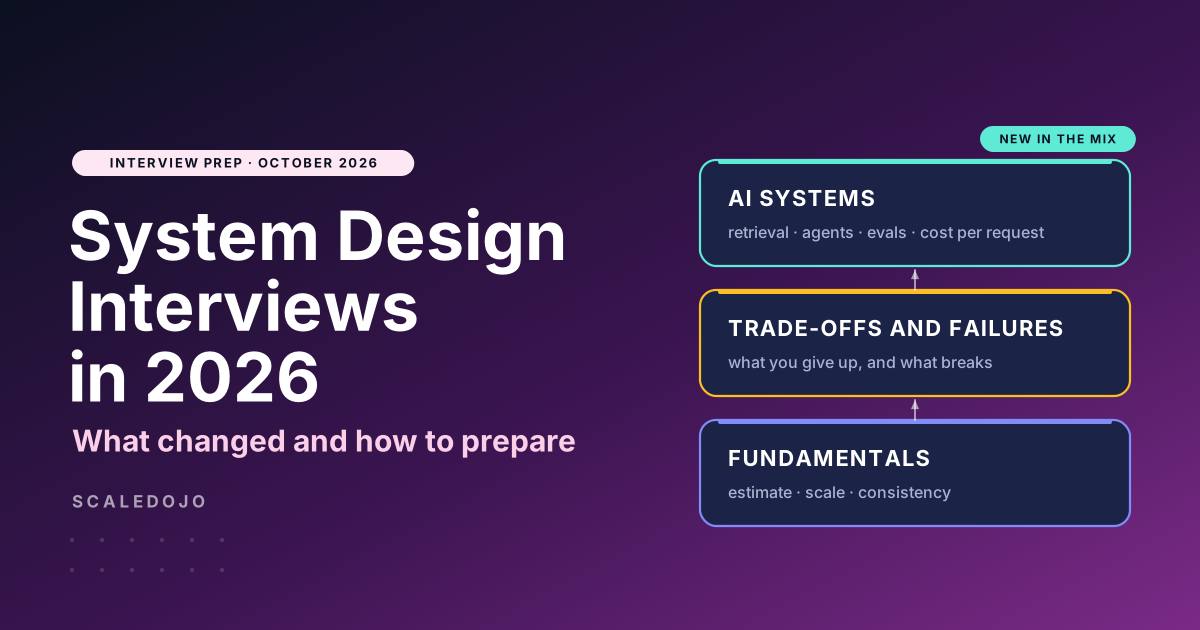
A system design practice platform helps you move beyond reading architecture diagrams and start applying what you know. Preparing for a system design interview takes more than memorizing answers: you have to make decisions, defend trade-offs, and explain your reasoning, and you only get good at that by doing it.
That is the idea behind ScaleDojo: an interactive platform where you build designs, break them, get feedback, and keep a record of your progress. With 546 challenges across seven labs, it covers more than high-level architecture alone.
Here are ten features that make ScaleDojo different from reading-only resources, and how each one helps your preparation.
1. An interactive architecture canvas for high-level design
In the HLD Architecture Lab, you build a system on a drag-and-drop canvas using load balancers, databases, caches, CDNs, message queues and workers. Challenges follow a clear progression, from a static app and a three-tier web app to a URL shortener, a rate limiter, a notification system, consistent hashing, a distributed message queue and an Uber-style driver matcher.
Take the URL shortener. You decide how traffic is distributed, where a cache belongs, how the database copes with more reads, and what happens when a component fails. You are not studying a finished diagram. You are making the decisions yourself.
Why it matters: applying concepts to a concrete problem builds the skill interviews actually test.
2. Instant scoring and an AI Architect Review
When you submit a design, ScaleDojo scores it with a deterministic scoring engine and adds an AI Architect Review. Depending on the challenge, feedback can cover functional correctness, latency, cost, reliability and architectural weaknesses.
A design that works at normal traffic can still hide a database bottleneck at higher load. The score and the review help you spot that, instead of guessing.
Why it matters: feedback turns practice into learning. Automated feedback does not replace your own reasoning, but it shows you where to look.
3. Murphy's Lab: break your design on purpose
Most practice stops once the diagram looks right. Murphy's Lab goes further with a chaos engineering simulator. You test your design against failures and see whether patterns such as circuit breakers, retries and graceful degradation actually hold up.
This is the kind of thinking interviewers look for when they ask, "What happens when this service goes down?" You can read more about the idea in the chaos engineering chapter of the HLD course.
Why it matters: designing for failure is what separates a diagram from a production-ready system.
4. Draw Your Own Design
Not every idea fits a predefined challenge. Draw Your Own Design gives you a free-form canvas with more than 40 cloud components. You can sketch your own architecture, run a load test on it, and export it as an image for a design doc or your portfolio.
It also works for interview rehearsal. Use it like a whiteboard, then check how your design behaves under load.
Why it matters: a free canvas lets you practice any problem, not only the ones in the catalog.
5. Database schema design and SQL practice
System design also means modeling data. The Database Lab lets you design schemas on an ER canvas: tables, keys, relationships, constraints and normalization. The separate SQL Lab gives you query problems for working with data.
For example, you might model customers, products, orders and payments for an online store, then decide which fields are keys and where an index would help.
Why it matters: schema design and SQL are common interview topics, and they connect directly to the architecture decisions you make at a higher level.
6. API design challenges
The API Design Lab covers REST endpoints, HTTP methods, request and response payloads, status codes, pagination and error handling. A typical exercise is designing the API for a notification service: how clients create notifications, check delivery status, handle bad requests and page through results.
Why it matters: APIs are the contracts between services. Good API design is part of almost every system design discussion.
7. GenAI and machine learning practice
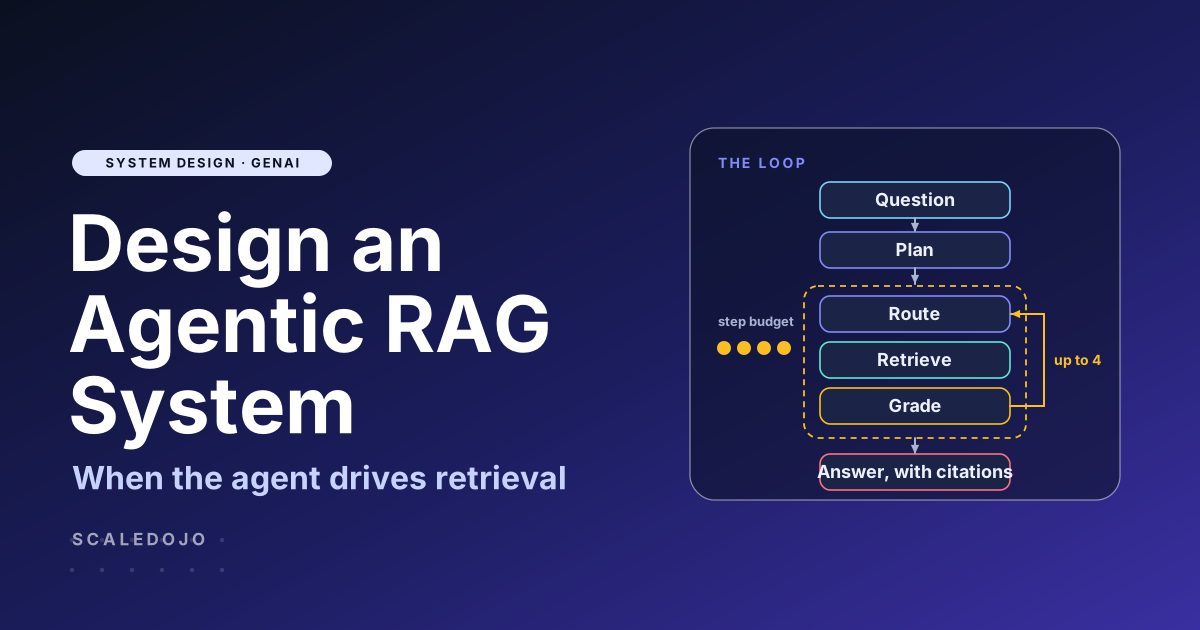
The GenAI Systems Lab covers retrieval-augmented generation (RAG), vector databases, AI agents, model routing and guardrails. The AI Lab goes into machine learning algorithms.
Think of a document question-answering app. You have to connect ingestion, chunking, embeddings, vector search and a language model, and decide what to do when retrieval quality, latency or cost becomes a problem.
Why it matters: AI-powered applications are now part of many system design conversations, and the same trade-off thinking applies.
8. Structured courses and a personalized AI roadmap
If you are not sure where to start, ScaleDojo has five Learn courses with more than 350 chapters in total: HLD fundamentals, LLD and schema design, API design, algorithms in Python, and AI engineering. A personalized AI roadmap and the public roadmap help you pick a path.
You can learn a concept in a chapter, then apply it in the matching lab.
Why it matters: a clear path stops you from jumping randomly between topics.
9. A reference library: wiki, papers and origin stories
ScaleDojo also includes a System Design Wiki with concept pages such as CAP theorem, sharding and consistent hashing, an interview cheat sheet, and a papers library with classics such as Dynamo, Raft, MapReduce and Paxos. The Origin Files explain how the core ideas of each lab came about.
Why it matters: knowing why a technique exists makes it easier to explain trade-offs in an interview.
10. Mock interviews, certificates and a leaderboard
Practice is more motivating when you can see progress. ScaleDojo offers a Mock Interview Arena on eligible plans, verifiable certificates with a public verification page that you can share on LinkedIn or X, and a global leaderboard.
Why it matters: a certificate and a track record give you something concrete to show, and mock interviews help you practice explaining your design out loud.
Start free
You don't need a credit card to try ScaleDojo. The free Explorer plan gives you access to selected challenges with limited credits, so you can test the experience before deciding on a paid plan. Check the pricing page for current plan details.
How to use ScaleDojo in your interview preparation
Learn the basics. Study caching, load balancing, replication and partitioning.
Attempt a challenge. Identify the requirements and build your design before you look at any solution.
Review the feedback. Look at the score and the AI review for bottlenecks and missing components.
Improve and retest. Change the design and see whether the weakness is gone.
Explain your decisions out loud. Practice saying why you chose each component and how the design handles growth and failure.
You will not build a perfect architecture on the first try. The goal is to get better at reasoning through problems.
Who can benefit from ScaleDojo?
Software engineers preparing for interviews: practice common problems and learn to explain your choices.
Developers moving toward backend work: build familiarity with databases, caching, APIs and distributed components.
Students and early-career developers: learn through guided, hands-on challenges.
Engineers exploring AI infrastructure: practice designing RAG pipelines and other GenAI components.
Results depend on your starting point and how consistently you practice.
Frequently asked questions
What is a system design practice platform? A system design practice platform helps developers apply architectural concepts through hands-on exercises, design challenges and feedback, instead of only reading about them. Depending on the platform, it may include interactive diagrams, automated evaluation and interview preparation resources.
What makes ScaleDojo different? ScaleDojo combines an interactive architecture canvas with automated scoring and AI review, a chaos engineering simulator, and separate labs for schema, API, SQL and GenAI design, plus structured courses and certificates.
What is ScaleDojo? ScaleDojo is an interactive platform for practicing system design and related engineering skills through hands-on challenges, an architecture canvas and automated feedback.
Is ScaleDojo suitable for beginners? Yes. You can start with introductory challenges and the Learn courses, then move on to harder problems. Some advanced challenges assume knowledge of databases, networking or distributed systems.
Can I practice system design interviews on ScaleDojo? Yes. The HLD challenges cover common interview problems, and a Mock Interview Arena is available on eligible plans. Also practice explaining your requirements, trade-offs and decisions out loud.
Does ScaleDojo offer a free plan? Yes. The Explorer plan includes selected challenges and limited credits, with no credit card required.
Do I get a certificate? ScaleDojo offers verifiable certificates with a public verification page. Check the platform for the certificate types and requirements.
Start building your system design skills
Understanding concepts is the first step. Applying them is what builds real architectural judgment. With an interactive canvas, instant feedback, chaos simulations, schema, API and AI labs, courses and certificates, ScaleDojo gives you one place to practice all of it.
Ready to move from reading architectures to building them? Explore ScaleDojo's challenges and start with a problem that matches your level.