Stripe's interview is the one many engineers say feels least like an interview. You work in a real editor, read a real codebase, call a real API, and are judged on whether your code would survive in production. This guide lays out the loop round by round, what each round is really checking, and how to prepare for it.
How we put this together. Stripe's own careers page confirms only the outline: a recruiter screen, a technical or skills-based assessment, and a series of interviews with the team. The round-level detail below is the shape that several public, candidate-written accounts agree on, read in October 2026. Where accounts differ, or only one says something, we say so or leave it out. Stripe has not confirmed the detail, so check it with your recruiter.
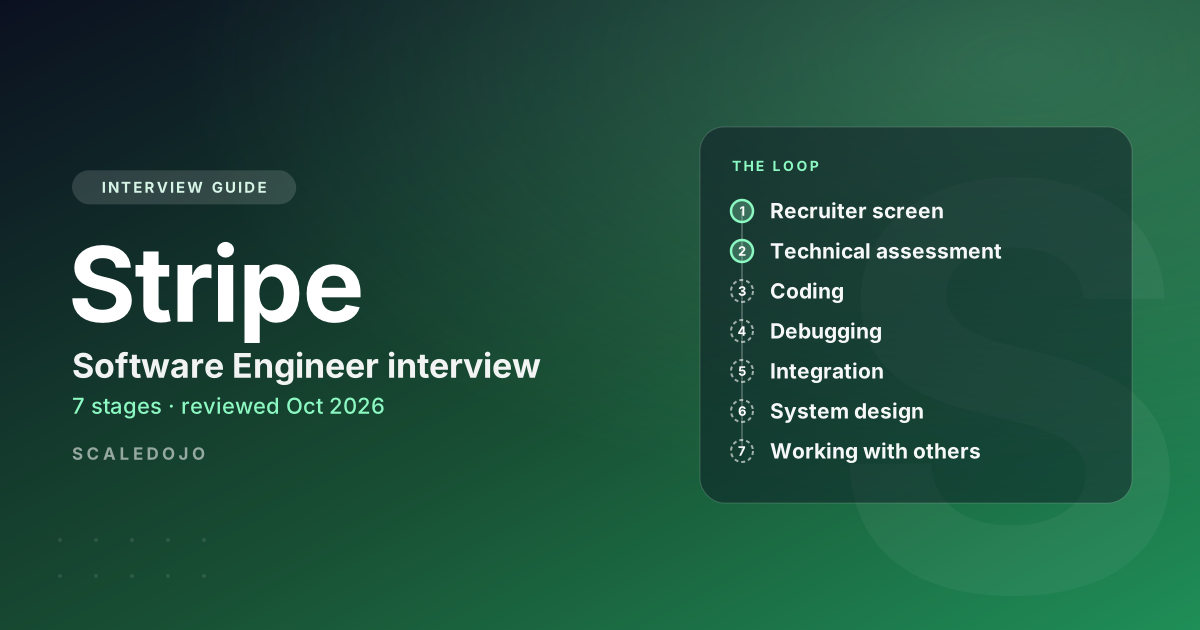
The loop at a glance
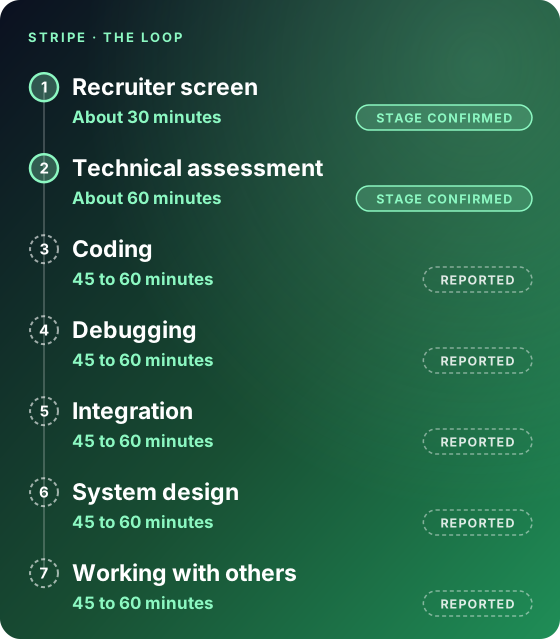
| Stage | Typical length | What happens | How sure are we |
|---|---|---|---|
| Recruiter screen | About 30 minutes | Your background, why Stripe, the level you are aiming for, practical matters. | Stripe confirms the stage; the length is reported |
| Technical assessment | About 60 minutes | Live coding with an engineer on a practical problem. | Stripe confirms a technical or skills-based assessment; the format is reported |
| Coding | 45 to 60 minutes | A second practical coding round, similar in spirit to the assessment. | Reported |
| Debugging (often called bug squash) | 45 to 60 minutes | You get a small project with failing tests and fix what is wrong. | Reported |
| Integration | 45 to 60 minutes | You build a small feature against an unfamiliar codebase or an HTTP API, with the documentation open. | Reported |
| System design | 45 to 60 minutes | Design with a lean towards APIs, reliability and developer experience. | Reported |
| Working with others | 45 to 60 minutes | Collaboration, ownership, how you handle disagreement. | Reported |
Accounts put the later loop at four to six interviews, and not every candidate sees every round. The whole process is described as taking anywhere from two to eight weeks, so ask your recruiter for the schedule rather than assuming.
What makes Stripe different
- It is open-book. In the debugging and integration rounds you work in your own setup and read documentation, as you would on the job. Nobody expects you to memorise an API.
- The bar is production quality. Clear names, handled errors and a test for what you changed matter. Code that merely passes is not the finish line.
- Correctness under failure keeps coming up. Stripe moves money, so retries, duplicate requests and half-finished operations are the main case, not an edge case. Expect to be asked what happens when the network drops halfway.
- Your working style is visible. Reading before typing, saying what you expect before you run something, and using the debugger instead of guessing all count.
Round by round
Recruiter screen
A short call about your background, why Stripe, the level you are targeting and logistics such as timing and location. Use it to ask what the technical assessment looks like for your role, because Stripe says that varies. Have a two-minute, honest account of what you have built and what you want to build next.
Technical assessment and coding
Accounts describe practical problems rather than algorithm puzzles: parsing structured input, validating it and applying rules to records. The difficulty is usually described as easy to medium, but the work is in reading the statement closely and handling the awkward cases. You can normally use the language you know best, and a working simple version beats an unfinished clever one.
- Read the whole statement before you type, then list the inputs that could surprise you: empty, duplicated, malformed, out of order.
- Get a simple version running first, then improve it. Say your assumptions out loud when the statement is ambiguous.
- Leave time to test with your own examples. Interviewers notice when you do.
Practise on ScaleDojo: the Forge modules on Array & String Techniques and Hashing, then problems where the real task is parsing and bookkeeping.
Debugging round
You are given a small project, usually with failing tests, and asked to find and fix the causes. It rewards calm over cleverness: read the failing test, reproduce the problem, form a guess, check it, fix it, run the tests again. Some bugs are easy and some hinge on a subtle edge case or a language feature.
- Start from the failing test and walk inward, instead of reading the whole project top to bottom.
- Say what you expect to happen before each run, then compare it with what did.
- Practise on code you did not write: break a small open-source project on purpose and fix it using only the test output.
Integration round
You implement a small feature against an unfamiliar codebase or an HTTP API, with its documentation open. Accounts describe it as closer to design than to coding: the skill is reading the docs quickly, sending the request, parsing the response, handling errors and shaping your code so it is easy to extend. Getting the response format right and managing the clock are the usual stumbling blocks.
- Call a public API with plain HTTP from your main language. Handle a client error and a server error differently.
- Add pagination, then add a safe retry. Ask yourself what happens if the first request actually succeeded.
- Keep your code small and named well: someone will read it after you.
Practise on ScaleDojo: the API Design course, especially Querying, Errors & Contracts and Production REST II: Correctness & Scale.
System design
The design round tends to lean on API design: resources, error handling, versioning, and how a developer would actually use what you propose. Reliability and payments-flavoured problems come up often, such as an API that must create a payment safely when the client may retry, or a ledger that must never lose or invent money. Scale still matters, but accounts stress developer experience alongside it.
Practise on ScaleDojo: the HLD modules on Consistency & Availability, Asynchronous Systems and Distributed Transactions & Resilience, then the Event-Driven APIs module for webhooks.
Working with others
The behavioural round is about collaboration and ownership. Stripe publishes six operating principles on its Life at Stripe page, including putting users first and collaborating without ego. Use them as a lens when you choose your stories, but tell the truth: pick real moments where you made a call under pressure, handed a problem to a teammate or changed your mind.
How the loop differs by level
Stripe's page does not split the process by level, and the public accounts do not agree on the details, so we will not invent a table for it. Our reading, which is not a Stripe statement: the more senior the role, the larger the share of the loop that is design and discussion, and the more you are expected to run the design round yourself with little prompting. Ask your recruiter how your level is weighted.
A six-week preparation plan
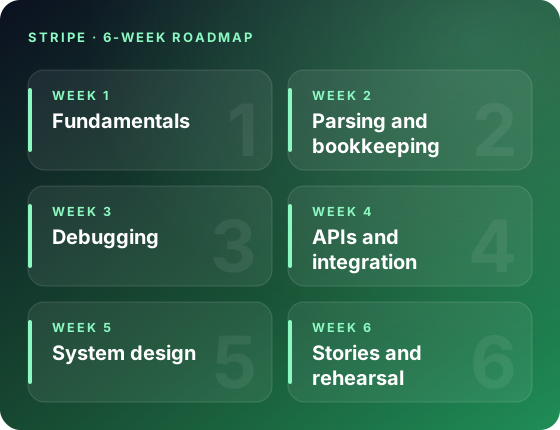
- Week 1, fundamentals. Strings, arrays and hashing in Forge. Practise reading a statement and listing edge cases before you code.
- Week 2, parsing and bookkeeping. Log lines, transactions, balances, intervals. Time-box each problem to 45 minutes.
- Week 3, debugging. Break a small project and fix it using tests and a debugger only.
- Week 4, APIs and integration. The API Design modules above, plus calling a real API and handling failure.
- Week 5, system design. Two or three payments-flavoured designs (idempotent create, a ledger, webhook delivery), then a full mock in the Mock Arena.
- Week 6, stories and rehearsal. Write six stories, say each aloud, and run one coding mock and one design mock back to back.
If you want the schedule built for you, the Interview plan tab in Revision lays out a day-by-day plan from the weeks and hours you have, ticks off what you finish, and brings the weak topics back through spaced revision. Stripe's plan is part of Pro.
Practice prompts
These are our own, written for practice. They are not questions anyone reports being asked.
- Given API requests with timestamps and customer ids, return the customers who made more than 100 requests in any one-minute window.
- A payments endpoint receives the same request twice. What must you store, for how long, and what do you return the second time?
- Parse a CSV of invoices that contains a quoted comma and a missing column, and total each customer's balance.
- A test fails in a small repository you have never seen. Describe how you find the cause before you change any code.
- Design webhook delivery for a payments API so a merchant never misses an event, even through an outage.
- Design a refunds API: partial refunds, several refunds per payment, and a clear error when the total would exceed the charge.
Questions to ask your recruiter
- Which rounds will I have, and how long is each?
- Is the debugging or integration round in my own editor, and which languages are allowed?
- Do I need anything installed or set up in advance?
- How is system design weighted for my level?
- What does the technical assessment cover for this team?
What we know and what we do not
Stripe has not published the round details above, so some of it will vary by team or change. We have not included any question a candidate says they were asked, and nothing here is a promise about what you will see. If your recruiter tells you something different, believe your recruiter. Last reviewed in October 2026.