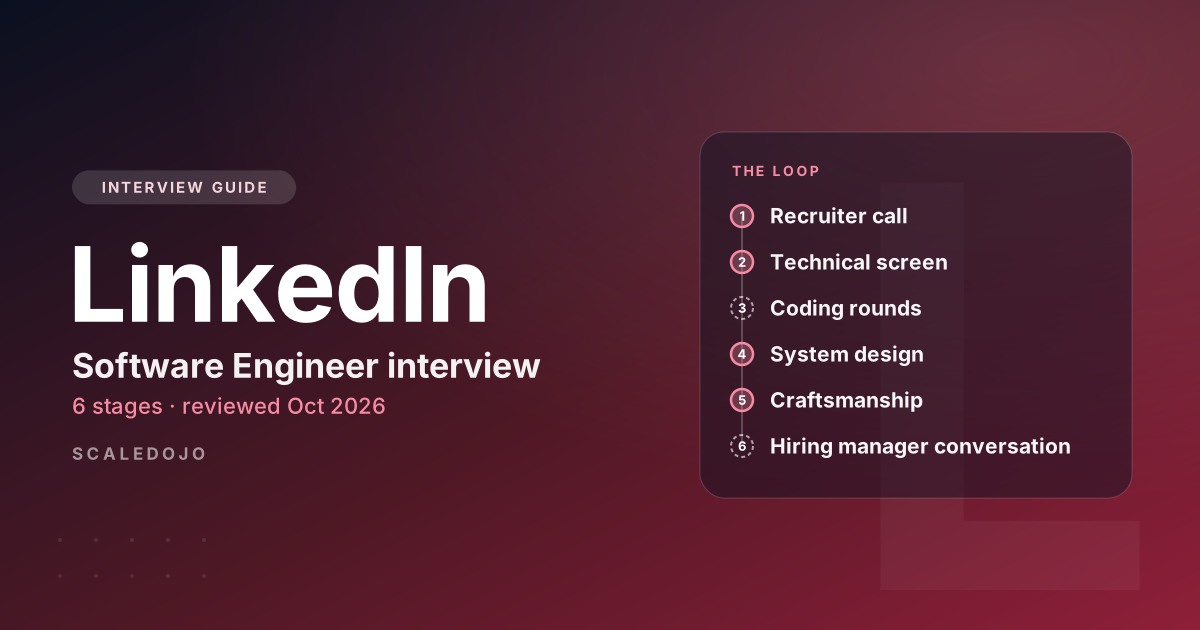
LinkedIn's engineering interview has two things that set it apart from a plain algorithms loop: a round that is explicitly about code craftsmanship, and, for many candidates now, a coding round where an AI assistant sits next to the editor. This guide walks through the loop, what each round is judging, and how to prepare.
How we put this together. LinkedIn's engineering careers page confirms the outline: an introductory conversation with an engineering recruiter, a technical interview, then interviews with a few engineers and leaders that may explore communication, coding, craftsmanship, engineering design and architecture, and leadership. The round-level detail below is the shape that several public candidate accounts agree on, read in October 2026. LinkedIn has not confirmed it, loops vary by role and level, and where accounts disagree we say so.
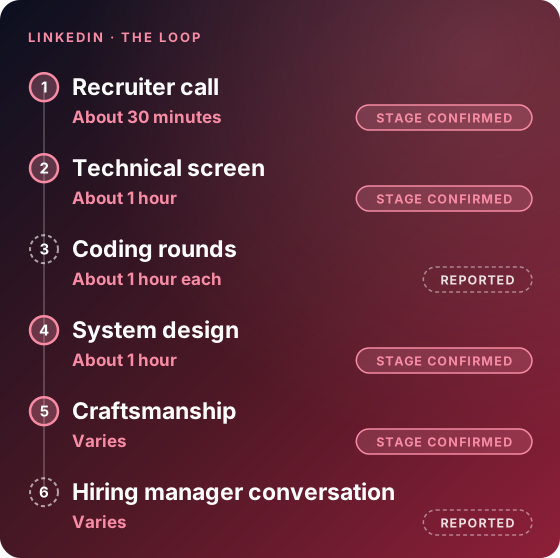
The loop at a glance
| Stage | Typical length | What happens | How sure are we |
|---|---|---|---|
| Recruiter call | About 30 minutes | Background, interests and fit. The recruiter walks you through the process and shares preparation resources. | LinkedIn confirms the stage and the resources; the length is reported |
| Technical screen | About 1 hour | Live coding, reported as a couple of problems of rising difficulty. | LinkedIn confirms a technical interview; the format is reported |
| Coding rounds | About 1 hour each | One traditional coding round, and in many loops a second one with an AI assistant available. | Reported |
| System design | About 1 hour | Design a large system, justify technology choices, communicate clearly. | LinkedIn names engineering design; the round is reported |
| Craftsmanship | Varies | Code quality, structure, tests and how you reason about maintainability. | LinkedIn names craftsmanship; the round is reported |
| Hiring manager conversation | Varies | Your projects, impact, leadership and fit with the team. | Reported |
At least one account says the loop is run centrally and that team matching comes after the interviews rather than before them. The exact set of rounds varies by role and level, so treat the table as a map and ask your recruiter for your actual schedule.
What makes LinkedIn different
- Craftsmanship is a named skill. LinkedIn lists it on its own page, and accounts describe a round where the shape of your code matters as much as whether it runs.
- An AI assistant may be part of a coding round. Candidates in 2026 describe a coding round that replaces one of the two traditional ones, held in a shared editor with an assistant panel beside it. Ask your recruiter whether your loop includes it.
- Follow-ups push toward production. After a first working solution, interviewers reportedly go on to concurrency, thread-safety and what changes at scale.
- It reads people's communication closely. The skills LinkedIn names, communication and leadership among them, are things you can only show by explaining your decisions clearly.
Round by round
Recruiter call
A friendly screen for your background and what you are looking for. LinkedIn says your recruiter shares preparation resources at each stage, so ask for them and ask which rounds your role includes, especially whether one involves an AI assistant.
Technical screen
A live coding session of about an hour. Accounts describe a small warm-up problem followed by a harder one, and say AI tools are not allowed in this round. Practise speaking while you code: say the approach before you type, run through an example by hand, and state the complexity at the end.
Practise on ScaleDojo: the Forge modules on Hashing, Stacks & Queues, Heaps & Priority Queues and Graph Fundamentals, then the Algorithms Behind Caching module, because cache-style problems with eviction rules are a recurring shape in accounts.
Traditional coding round
The familiar format: a well-known kind of problem, such as caches with an eviction rule, interval merging or transforming structured data, then follow-ups. The follow-ups are where rounds are won. Be ready to talk about what breaks when two threads touch your structure, and how you would test it.
AI-assisted coding round
This is the newest part of the loop, and the least documented, so hold the details loosely. Accounts describe a shared editor with an assistant panel, a problem of familiar shape and a modest amount of code, and an assistant that is a helper rather than the centrepiece. In some accounts the assistant cannot edit your code directly, so you copy across what you choose, which makes every decision yours and visible.
What interviewers reportedly watch for is judgement, not speed:
- How you ask. A specific request that states the constraints beats a vague one.
- Whether you check the answer. Read what the assistant gives you, run it, and write your own tests rather than trusting it.
- Whether you can explain your choices. Why you accepted one suggestion, rejected another and changed a third.
- What you do after it works. Concurrency, error handling and what you would change to ship it.
A workflow worth rehearsing: restate the problem in your own words, ask for a plan or a first draft, read it line by line, write the tests yourself, tighten the code, then discuss production concerns. Rounds without the assistant are expected to be done without any outside tool, so follow the instructions you are given for each round.
System design
A large-system design of about an hour: scope it, sketch the architecture, choose storage and communication, and defend the trade-offs. LinkedIn's own business suggests useful practice: feeds, a social graph, search, messaging and notifications. Communication matters as much as the boxes you draw.
Practise on ScaleDojo: the HLD course from Databases 101 through Asynchronous Systems and Storage at Scale, then the Capstone Case Studies, and time-boxed mocks in the Mock Arena.
Craftsmanship
The round that is easiest to under-prepare. Expect to write or reshape code with an eye on structure: good names, small functions, clear responsibilities, tests, and the reasons behind each choice. A strong approach is to refactor in small steps and say what protects each step.
Practise on ScaleDojo: the LLD course, starting with OOP Foundations & UML and SOLID Principles, then the Concurrency for LLD module.
Hiring manager conversation
Part behavioural, part technical depth. Prepare two projects in detail: what the problem was, what you personally decided, what went wrong and what you would do differently. Use LinkedIn's own list as a lens, communication, craftsmanship, engineering design and leadership, and bring a true story for each.
How the loop differs by level
LinkedIn's page does not split the process by level, and the public accounts are not consistent about it. Our reading, not a LinkedIn statement: early-career loops lean on coding fundamentals, while senior loops give more room to design, leadership and the conversation about your past work. Ask your recruiter what is weighted for your level.
A six-week preparation plan
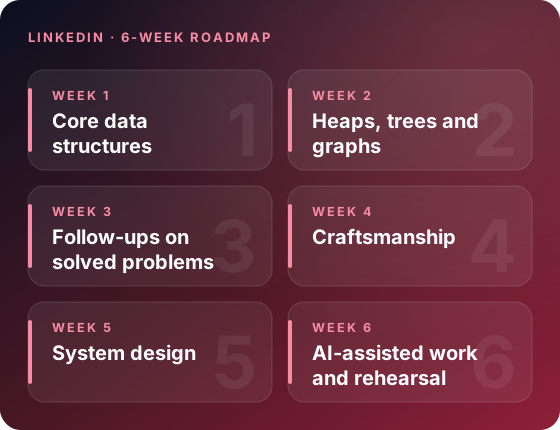
- Week 1. Core data structures in Forge: hashing, stacks and queues, linked lists. Speak your approach aloud every time.
- Week 2. Heaps, sorting, trees and graphs. Add intervals and caching problems with eviction rules.
- Week 3. Follow-ups. Take each problem you solved and ask what happens with two threads, a huge input or a failing dependency.
- Week 4. Craftsmanship. Refactor messy code in small steps, with tests, and write down the reason for each change.
- Week 5. System design: a feed, search and a notifications digest. Two full mocks in the Mock Arena.
- Week 6. The AI-assisted workflow, stories and a dress rehearsal. Practise with an assistant of your own: ask precisely, verify, test, explain.
The Interview plan tab in Revision turns your weeks and hours into a daily schedule, ticks off what you finish, and feeds your weak topics back through spaced revision. LinkedIn's plan is part of Pro.
Practice prompts
These are our own, written for practice. They are not questions anyone reports being asked.
- Build a cache with a size limit and a least-recently-used rule, then make it safe for two threads and explain how you would test that.
- Insert a new time range into a sorted list of ranges and return the merged list. How does your answer change if the ranges arrive as a stream?
- You are given a 60-line function that parses, validates and saves a record. Refactor it in small steps and name the test that protects each one.
- Review a 200-line pull request: list what you would ask the author before approving, in order of importance.
- Design a job-alert system that emails a member only when a new posting really matches what they want.
- Explain to a new teammate, in five minutes, how you would add rate limiting to a service that has none.
Questions to ask your recruiter
- Which rounds will I have, and how long is each?
- Is one of my coding rounds held with an AI assistant, and which tools are allowed in the others?
- Is the craftsmanship round written code, a refactor or a conversation?
- Will the loop happen before or after I am matched to a team?
- What preparation resources can you share?
What we know and what we do not
LinkedIn has not published the round details above, the AI-assisted format is new and changing, and loops differ between roles. We have not included any question a candidate says they were asked, and nothing here is a promise about what you will see. If your recruiter tells you something different, believe your recruiter. Last reviewed in October 2026.