PayPal's interview is an engineering interview at a company whose product is trust in other people's money. That shapes it: you are asked to write working code and to explain it clearly, and the design round tends to be about getting money movement right, not just fast. This guide walks through the loop, what each round is judging, and how to prepare.
How we put this together. PayPal's own Interviewing page says a recruiter calls first, then team members interview you virtually, and it gives preparation advice. It does not describe the technical rounds. The round-level detail below is the shape that several public candidate accounts agree on, read in October 2026. PayPal has not confirmed it, loops vary by team and level, and where accounts differ we say so.
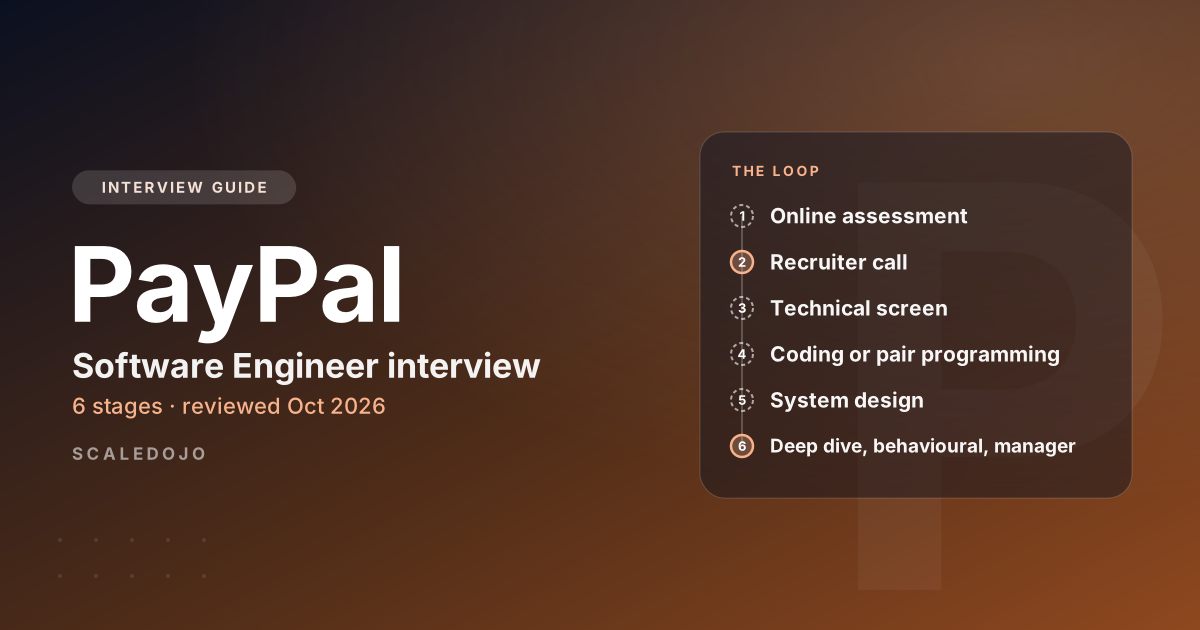
The loop at a glance
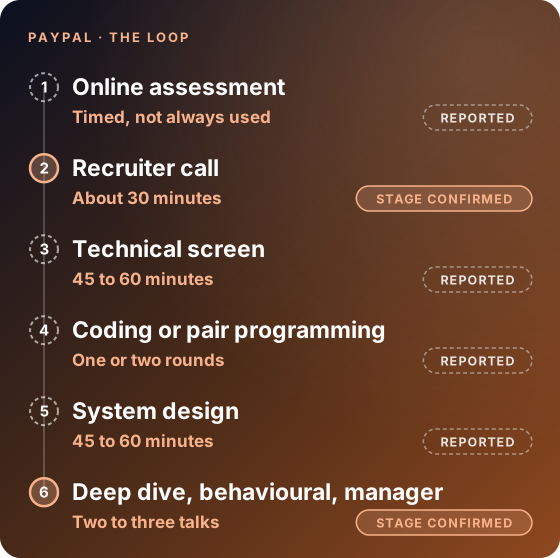
| Stage | Typical length | What happens | How sure are we |
|---|---|---|---|
| Online assessment | Not always used; timed | Coding problems and some object-oriented or language questions on an assessment platform. | Reported |
| Recruiter call | About 30 minutes | Your experience, motivation, the role and logistics. | PayPal confirms the stage; the length is reported |
| Technical screen | 45 to 60 minutes | Live coding in a shared editor, sometimes run by an outside interviewing service and sometimes by a PayPal engineer. | Reported |
| Coding or pair programming | One or two rounds | Collaborative problem solving where working, readable code and teamwork both count. | Reported |
| System design | 45 to 60 minutes | A distributed design with a strong lean towards payments correctness. | Reported |
| Project deep dive, behavioural and hiring manager | Two to three conversations | Your past work in detail, your competencies and your fit with the team. | PayPal confirms team interviews; the shape is reported |
PayPal's page says interviews are currently held virtually, and accounts put the whole process at a few weeks. How many rounds you get depends on the team and the level, so ask your recruiter for the real list.
What makes PayPal different
- Money correctness is the theme. Idempotency, consistent balances, reconciliation and what happens when part of a transfer fails come up in design conversations more than raw scale does.
- Reasoning aloud counts as much as the answer. Several accounts say they expected a pure algorithm grind and found a process that rewarded explaining assumptions, handling a new constraint and walking through trade-offs.
- Detailed accounts of your own work are expected. PayPal's page asks for a specific, detailed account for each competency, and advises varying your examples across jobs and being honest without embellishing.
- Values and leadership principles are part of it. PayPal says to learn its company values and Leadership Principles. They are on its own site, so read them there.
Round by round
Online assessment
Not every candidate gets one. Where it is used, accounts describe a timed set of coding problems of easy to medium difficulty, sometimes with language or object-oriented questions. Practise finishing a clean, correct solution under a clock and keep a few minutes at the end for your own tests.
Practise on ScaleDojo: Forge problems on Array & String Techniques, Hashing and Sorting Algorithms, timed, with an extra pass for edge cases.
Recruiter call
PayPal says recruiters call to talk about the position and your experience. Be ready to summarise your recent work, why you are interested in payments, and what you are looking for. Ask which interviews your team uses.
Technical screen
A live coding round of 45 to 60 minutes. Accounts describe problems of moderate difficulty and an interviewer who cares about whether you state assumptions, explain your reasoning and arrive at working code. Say what you plan to do before you do it, and test with a small example before you call it done.
Coding or pair programming
One or two longer sessions where you build something collaboratively. The interviewer is looking at how you respond to hints and changed requirements, and whether the code you leave is something a teammate could pick up. Ask clarifying questions early; they are rewarded.
Practise on ScaleDojo: the LLD course, especially OOP Foundations & UML, SOLID Principles and Behavioral Patterns, and then design a small system in code in 45 minutes.
System design
Expect a distributed design with a payments flavour. Accounts mention themes such as idempotent requests, ledger consistency and reconciliation between systems. The good answers start by stating what must never happen (money created, lost or applied twice), then design backwards from there.
- Make every money-moving call safe to retry, and say how you detect a duplicate.
- Prefer an append-only record of what happened over editing balances in place.
- Plan for the case where two systems disagree, and say how you find and fix the difference.
Practise on ScaleDojo: the HLD modules on Consistency & Availability, Asynchronous Systems and Distributed Transactions & Resilience, Advanced Transactional Modeling in LLD, and the API Design module on correctness.
Project deep dive, behavioural and hiring manager
Pick two projects and prepare them to a level where you can answer five follow-ups in a row: what was the goal, what did you personally decide, what failed, how did you know, what would you change? For behavioural questions, follow PayPal's own advice: a specific account for each competency, with different examples from different jobs.
How the loop differs by level
PayPal's page does not split the process by level and the accounts do not agree on the details. Our reading, not a PayPal statement: early-career loops lean on coding fundamentals and object design, while senior loops put more weight on the payments-style design round and on the depth of your past work. Ask your recruiter how your level is weighted.
A six-week preparation plan
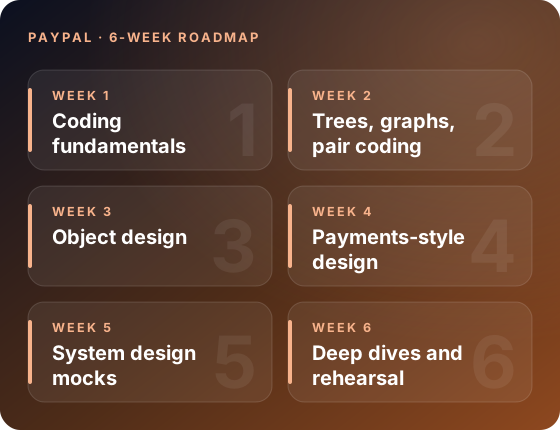
- Week 1. Coding fundamentals under a clock: arrays, strings, hashing, sorting. Practise explaining each solution out loud.
- Week 2. Trees, graphs and recursion. Add one pair-programming rehearsal with a friend who changes the requirements midway.
- Week 3. Object design: model a small payments domain in code and keep it open to extension.
- Week 4. Payments-style design basics: idempotency, ledgers, retries and reconciliation, using the modules above.
- Week 5. Two full system design mocks in the Mock Arena, then one on your weakest topic.
- Week 6. Project deep dives and competency stories, then a full dress rehearsal.
The Interview plan tab in Revision builds the daily schedule from your weeks and hours, ticks off what you finish and brings weak topics back through spaced revision. PayPal's plan is part of Pro.
Practice prompts
These are our own, written for practice. They are not questions anyone reports being asked.
- Design an API to move money between two accounts so a retry never moves it twice.
- Reconcile two lists of transactions, one from your system and one from a bank, and report what differs and why.
- Design a ledger where every entry has a matching entry and any balance can be rebuilt from history.
- Given payment events that may arrive late or out of order, compute each merchant's settled total per day.
- Explain idempotency to a new teammate using a payment as the example, then name one way it can still go wrong.
- Model a refund policy with time limits, partial refunds and different rules per payment method, so that adding a rule does not change existing code.
Questions to ask your recruiter
- Which rounds will I have, and how long is each?
- Is there an online assessment, and which languages does it support?
- Is the technical screen run by an outside service or by a PayPal engineer?
- How is system design weighted for my level?
- Which values and Leadership Principles should I read before the interviews?
What we know and what we do not
PayPal's page confirms the recruiter call, the team interviews and the advice to prepare detailed examples, and nothing more about the technical rounds. The rest is the shape accounts agree on, which can differ by team and change over time. We have not included any question a candidate says they were asked, and nothing here is a promise about what you will see. If your recruiter tells you something different, believe your recruiter. Last reviewed in October 2026.