Salesforce publishes interview guidance for engineers: its Trailhead learning platform has modules written for software engineer candidates. Some of that advice is older than the way the Salesforce software engineer interview is now run. This guide combines the official material with what candidates describe, round by round, and says which is which.
How we put this together. Salesforce's hiring page says most conversations are virtual, on camera, with an in-person office visit before an offer. Two Trailhead modules, one on the virtual technical screen and one on the on-site day, describe the technical stages. They are undated and parts may predate virtual interviews. The rest is the shape several public candidate accounts agree on, read in October 2026; Salesforce has not confirmed it.
The loop at a glance
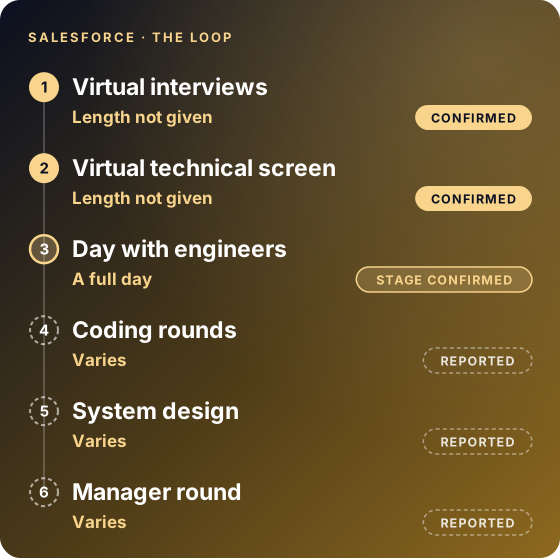
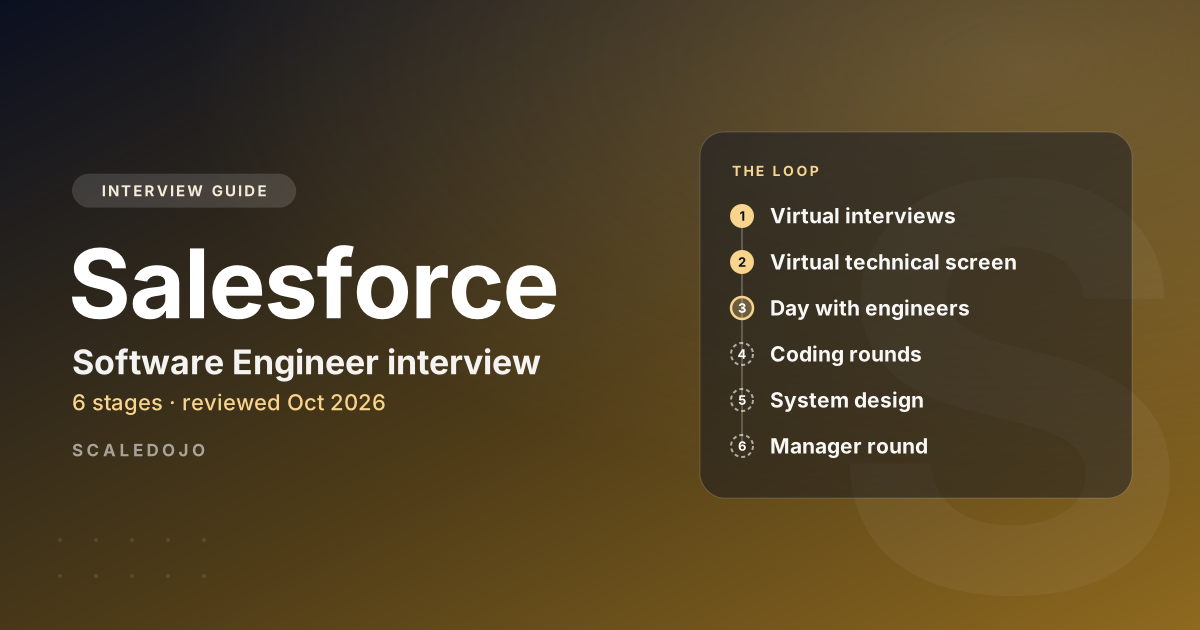
The Salesforce loop. Solid markers are confirmed by Salesforce. Tinted markers are stages Salesforce names, with the detail from candidates. Dashed markers are reported by candidates. Confirm your own schedule with your recruiter.
Stage | Typical length | What happens | How sure are we |
|---|---|---|---|
Virtual interviews | Not given | Conversations on Google Meet with your camera on, using behavioural, competency-based and situational questions. | Salesforce confirms it |
Virtual technical screen | Not given | A call about your resume and goals, then a design problem and coding in your chosen language on a shared screen. | Salesforce's Trailhead guide says so |
Day with engineers | A full day | Three interviews with different engineers and a lunch with the hiring manager; each mixes technical and behavioural questions, with coding on a whiteboard. | Salesforce's Trailhead guide says so; may predate virtual interviews |
Coding rounds | Varies | For senior roles, accounts describe about three coding rounds in total, more practical than the screen. | Reported |
System design | Varies | A design round built around a real business problem. | Reported |
Manager round | Varies | Mostly behavioural questions with the hiring manager. | Reported |
Salesforce's hiring page says an office visit is required before an offer, so even a mostly virtual loop ends in person. Ask your recruiter how the stages above map to your own schedule.
What makes Salesforce different
Technical and behavioural questions are mixed. The Trailhead guide says every interviewer asks both, so you cannot save your stories for one round.
You are asked to narrate. Salesforce's guidance repeats the point: think aloud, explain decisions and decompose problems visibly.
The design problem starts early. The first technical call already includes a design problem alongside coding.
Interviewers may change midway. Salesforce says it sometimes adds or swaps interviewers during the day to see how you adapt, so stay steady when the room changes.
Round by round
Virtual interviews
Salesforce says interviewers use behavioural, competency-based or situational questions and look at how your skills and experience tie back to the role. Reread the job description and prepare real examples that match it. The STAR method, situation, task, action, result, is Salesforce's own recommendation.
Virtual technical screen
A call with a member of the team. They talk through your resume and goals, then set a design problem and ask you to code in the language you prefer on a shared screen. The point is to watch how you decompose a problem, so say your plan before you type.
Find a quiet place and a stable connection, and test screen sharing in advance.
Practise coding while talking, with a time limit.
For the design part, state the requirements back before you propose anything.
Practise on ScaleDojo: Forge modules on Hashing, Stacks & Queues, Sorting Algorithms and Trees & Binary Search Trees, plus the LLD course on OOP Foundations & UML for the design part.
The day with engineers and the hiring manager
Salesforce's guidance describes three interviews with different engineers and a lunch with the hiring manager, with technical questions on a whiteboard in each. Treat each person as a new audience: research them on LinkedIn, as the guide suggests, and prepare a question for each. If your loop is held on video, the same discipline applies with a shared drawing tool.
Practise on ScaleDojo: the HLD course, especially Three-Tier Architecture & Scaling Up, Databases 101, Protecting Your System and Microservices & Service Architecture, then mocks in the Mock Arena.
Coding rounds
Accounts of senior loops describe about three coding rounds in total, with later ones resembling the screen but with a more practical flavour: records, rules, schedules and imports rather than puzzles. Prepare standard data structures and algorithms, and be ready to talk about how you would test and extend what you wrote.
System design
Accounts say most engineers get a design round built around a real business problem. Salesforce's business is a multi-tenant platform, so practise reasoning about tenant isolation, per-customer limits, workflows that run on behalf of customers, and audit trails. That is our suggestion for practice, not a list of questions.
Practise on ScaleDojo: the HLD modules above plus API Design, especially Auth & Versioning and Platform & Resilience.
Manager round
Mostly behavioural: how you work, decide and handle disagreement. Bring stories about customers, teammates and change. One honest story with a real cost is better than several polished ones.
How the loop differs by level
Salesforce's pages do not split the process by level. Public accounts of senior loops mention several coding rounds, one design round and a manager round. Our reading, not a Salesforce statement: earlier-career loops lean on coding, and senior loops add design and the way you influence others. Ask your recruiter how your level is weighted.
A six-week preparation plan
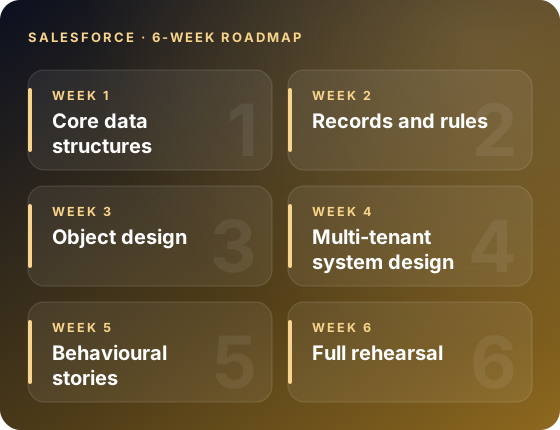
A 6-week order of preparation for the Salesforce loop. Stretch it or squeeze it to the time you have.
Week 1. Core data structures in Forge, practised aloud. Time every problem.
Week 2. Records and rules: matching, merging, scheduling and rule evaluation problems.
Week 3. Object design: accounts, contacts, permissions and validation rules in the LLD course.
Week 4. System design: multi-tenancy, limits, workflows and audit trails, with two mocks.
Week 5. Behavioural stories in STAR form, six of them, said aloud.
Week 6. A full rehearsal that mixes technical and behavioural questions in one sitting.
The Interview plan tab in Revision builds a daily schedule from your weeks and hours, ticks off what you finish and brings your weak topics back through spaced revision. Salesforce's plan is part of Pro.
Practice prompts
These are our own, written for practice. They are not questions anyone reports being asked.
Merge duplicate contact records that share an email address or a phone number.
Assign incoming leads by territory, then by size, then by round robin.
Design a customer platform where each company's data stays isolated from the others.
Design per-company limits so one busy customer cannot slow down the rest.
Design an automation engine that runs customer-defined rules when a record changes.
Tell me about a decision that shows what you value as an engineer.
Questions to ask your recruiter
Which rounds will I have, and are they virtual or in person?
Does the technical screen include a design problem, and how long is it?
Is the coding on a whiteboard, a shared editor, or my own setup?
How is system design weighted for my level?
Will I meet the hiring manager during the loop?
What we know and what we do not
Salesforce confirms the virtual conversations, the technical screen and the in-person visit, and gives no lengths or counts. The Trailhead guidance is undated, and the rest is the shape accounts agree on, which differs by team and changes over time. We have not included any question a candidate says they were asked, and nothing here is a promise about what you will see. If your recruiter tells you something different, believe your recruiter. Last reviewed in October 2026.