Oracle's software engineer interview follows a classic pattern: you solve problems in code, explain your thinking, and talk about how you work with other people. What sets it apart is the company's business. Oracle sells databases and cloud infrastructure, so engineers who can talk about data, consistency and failure have an edge. This guide covers the loop, what each round judges, and how to prepare.
How we put this together. Oracle publishes its own advice: an interview-preparation guide and two posts on its Jobs at Oracle blog, one on technical interviews and one on behavioural questions. They say what the interviews test and how to prepare, not how many rounds there are. The round structure below is what several public candidate accounts agree on, read in October 2026. Oracle has not confirmed it, and teams differ.
The loop at a glance
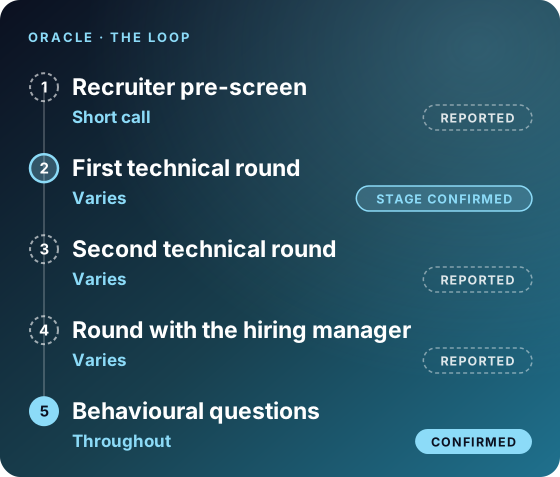
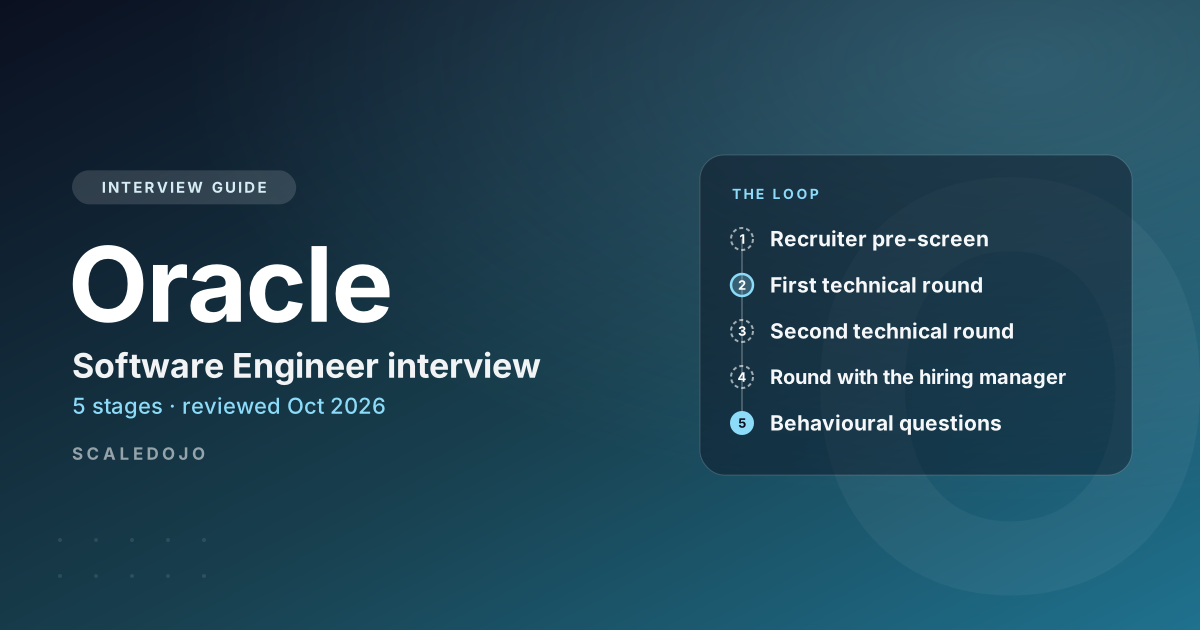
The Oracle loop. Solid markers are confirmed by Oracle. Tinted markers are stages Oracle names, with the detail from candidates. Dashed markers are reported by candidates. Confirm your own schedule with your recruiter.
Stage | Typical length | What happens | How sure are we |
|---|---|---|---|
Recruiter pre-screen | Short call | A check of your background and the role. | Reported |
First technical round | Varies | Coding on problem solving, technology fundamentals and concepts. | Oracle describes technical interviews; the structure is reported |
Second technical round | Varies | A deeper round that returns to areas the first left unclear. | Reported |
Round with the hiring manager | Varies | A mix of technical depth and situational questions about teamwork and decisions. | Reported |
Behavioural questions | Throughout | How you acted in real work situations, asked in the later rounds. | Oracle describes behavioural interviews |
Accounts put the loop at about four rounds including the pre-screen, and describe the first two technical rounds as the ones you must clear to continue. Ask your recruiter for your actual schedule, because teams and levels vary.
What makes Oracle different
Fundamentals are tested directly. Oracle's technical post names data structures, algorithms, sorting, recursion, searching, graph and tree algorithms, dynamic programming and big-O analysis. Expect the classic topics.
You are asked for code and a test. Oracle describes being given a problem, presenting a solution in code and, if time allows, writing a test case. Leave a few minutes for testing.
How you think is part of the score. The same post says interviewers want to see how you solve a problem, not only the answer, and how you reflect the company's values.
Data is the home turf. This is our reading rather than an Oracle statement: a company built on databases tends to reward people who can reason about transactions, consistency and failure.
Round by round
Recruiter pre-screen
A short call about your background, the role and logistics. Ask which languages are allowed, what the technical rounds look like for your team, and whether there is a hiring manager round.
Technical rounds
Oracle's own advice is to refresh the fundamentals and be ready to present a working solution. Accounts say the second round digs into areas where the first was unclear, so a weak spot found early will come back. Work from a list: arrays and strings, hash tables, linked lists, stacks and queues, trees, graphs, sorting and searching, recursion and dynamic programming.
State the approach and its cost before you code.
Write clear, working code, then a test with an edge case.
When you are stuck, say what you have ruled out. Oracle says it wants to see how you think.
Practise on ScaleDojo: Forge modules on Array & String Techniques, Hashing, Linked Lists, Recursion & Memoization, Trees & Binary Search Trees, Sorting Algorithms, Graph Fundamentals and 1D Dynamic Programming.
Round with the hiring manager
Accounts describe a conversation that mixes technical depth in your own work with situational questions: how you collaborate, how you decide. Know your CV cold, as Oracle advises, and pick two projects you can explain at every level of detail.
Behavioural questions
Oracle says behavioural questions ask how you would act in particular work situations, which reveals how you handled similar ones before. Prepare examples and tell each one with specifics: the situation, what you did, the result.
Practise on ScaleDojo: the LLD course on Relational Modeling Foundations, Intermediate Modeling Patterns and Advanced Transactional Modeling, and the HLD course on Databases 101, Consistency & Availability and Distributed Transactions & Resilience, which suit a data company well.
How the loop differs by level
Oracle's guidance does not split the process by level. Our reading, not an Oracle statement: early-career loops stay close to the fundamentals above, while experienced candidates should expect a design discussion and more weight on the hiring manager conversation. Ask your recruiter how your level is weighted.
A five-week preparation plan
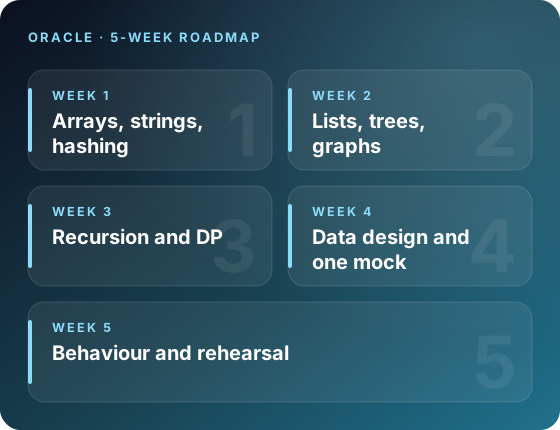
A 5-week order of preparation for the Oracle loop. Stretch it or squeeze it to the time you have.
Week 1. Arrays, strings, hashing and sorting in Forge, each solved with a test.
Week 2. Linked lists, trees and graphs. Time every problem.
Week 3. Recursion and dynamic programming, plus a second pass on anything that felt weak.
Week 4. Data design: relational modelling, transactions, replication and failure, with one system design mock.
Week 5. Behavioural examples, your CV in detail, and a full rehearsal.
The Interview plan tab in Revision builds a daily schedule from your weeks and hours, ticks off what you finish and brings your weak topics back through spaced revision. Oracle's plan is part of Pro.
Practice prompts
These are our own, written for practice. They are not questions anyone reports being asked.
Implement a fixed-size page cache that evicts the least recently used page.
Given a log of transactions on records, find the pairs that conflict.
Design a distributed key-value store and say what happens when a node fails.
Design backups and point-in-time restore for a large database.
Design the schema for a financial ledger that keeps a full audit history.
Tell me about a mistake in your own code and what you changed afterwards.
Questions to ask your recruiter
Which rounds will I have, and how long is each?
Which languages may I use in the technical rounds?
Will there be a system or database design round at my level?
Is there a round with the hiring manager, and what does it cover?
Are the technical rounds on a shared editor or a whiteboard?
What we know and what we do not
Oracle's own pages describe what technical and behavioural interviews test and how to prepare, with no counts or lengths, and the details may have moved on since they were written. The round structure is the shape accounts agree on, which differs by team and changes over time. We have not included any question a candidate says they were asked, and nothing here is a promise about what you will see. If your recruiter tells you something different, believe your recruiter. Last reviewed in October 2026.