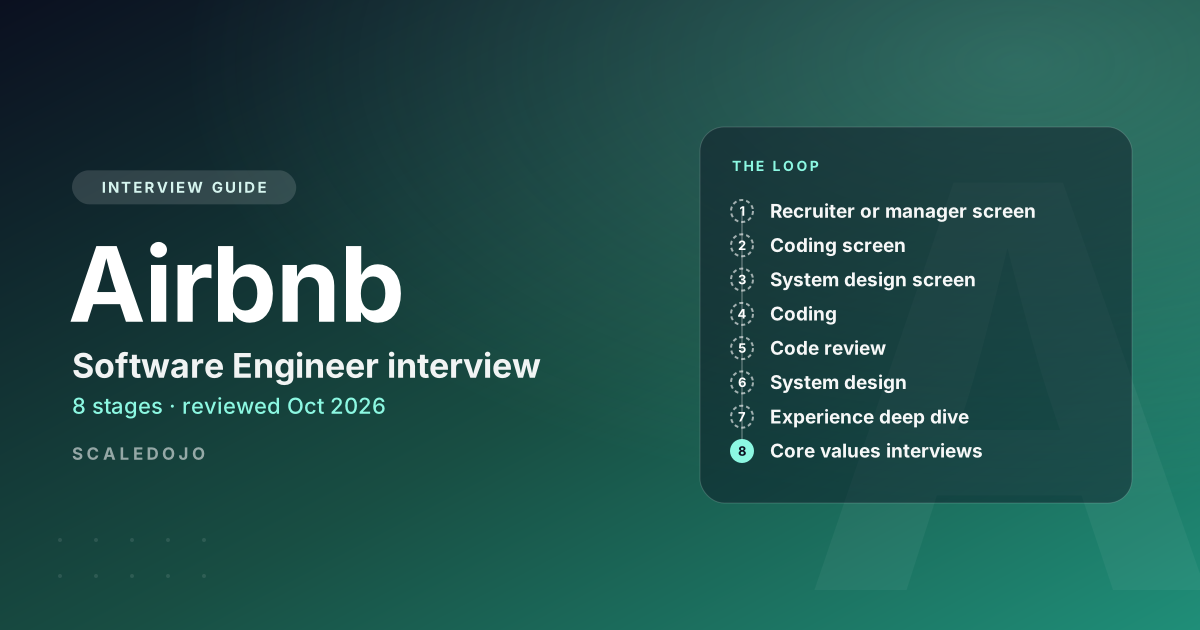
The Airbnb software engineer interview is practical, and it has two features that candidates often under-prepare: a round where you review someone else's code instead of writing your own, and interviews about the company's core values that are treated as a real gate rather than a formality. This guide walks through the loop and how to prepare for each part.
How we put this together. Airbnb's careers FAQ says that, depending on the role, the process may involve a test, a video or an event, and that you meet several people on the team. An engineering blog post on Airbnb's culture describes the core values interviews. Neither describes the technical rounds, so the round-level detail below is the shape that several public candidate accounts agree on, read in October 2026. Airbnb has not confirmed it, and where accounts differ we say so.
The loop at a glance
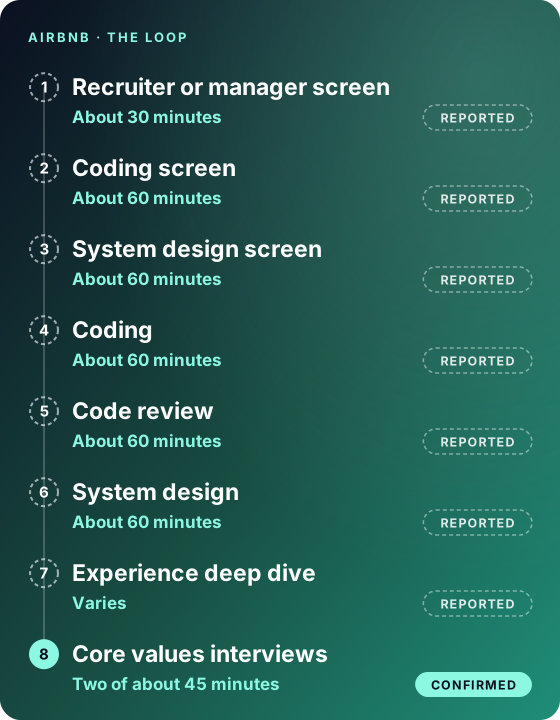
The Airbnb loop. Solid markers are confirmed by Airbnb. Dashed markers are reported by candidates. Confirm your own schedule with your recruiter.
Stage | Typical length | What happens | How sure are we |
|---|---|---|---|
Recruiter or hiring manager screen | About 30 minutes | Your background, the role and why Airbnb. | Reported |
Coding screen | About 60 minutes | One or two practical problems in a shared editor. | Reported |
System design screen | About 60 minutes | For senior candidates in many accounts, an early design conversation. | Reported; level-dependent |
Coding | About 60 minutes | Multi-part problems that grow as you solve them. | Reported |
Code review | About 60 minutes | You review a change and give feedback as you would to a teammate. Accounts say this replaced a second coding round around 2024. | Reported |
System design | About 60 minutes | Deeper design including operations and failure. | Reported |
Experience deep dive | Varies | Your past projects and technical decisions, mostly for experienced candidates. | Reported; level-dependent |
Core values interviews | Two interviews of about 45 minutes | Your motivations and how you behave in hard moments, judged against Airbnb's mission and values. | Airbnb describes these |
Accounts put the whole process at roughly three to five weeks, and Airbnb's FAQ says to expect a response within three to four weeks. Counts and names differ between accounts and levels, so ask your recruiter which of these rounds you will have.
What makes Airbnb different
Practical code, not puzzles. Accounts stress readable, production-quality code and problems that grow as requirements change. Bookings, dates and availability are natural practice material for a marketplace; that is our suggestion, not a reported question.
You read code in the interview. The code review round tests judgement, communication and how you help another engineer improve.
Culture is a gate. The blog post describes two 45-minute interviews on the company's mission and core values, and at least one account treats them as able to decide the outcome whatever your technical strength. Prepare as if they can.
Cross-functional thinking is expected. Airbnb builds a two-sided marketplace of guests and hosts, and good answers keep both sides in view.
Round by round
Screens
The first call is about you and the role. The coding screen is an hour in a shared editor with one or two practical problems. Aim for readable, working code and a calm explanation, and test with your own example before you say you are done.
Practise on ScaleDojo: Forge problems on Array & String Techniques, Hashing, Sorting Algorithms and Searching, always with a focus on clear code over clever code.
Coding
Multi-part problems are the pattern: a simple first version, then a new requirement, then another. The way to do well is to leave room in your design for the next requirement without building for it in advance, and to say so out loud. Dates, ranges and availability are good practice material.
Code review
The most distinctive round. You are shown a change, often with some flaws, and asked to review it. Good reviews are ordered and kind: correctness first, then risks, then maintainability, then style, and they explain why rather than only pointing.
Read the description and the whole diff before commenting.
Separate must-fix problems from suggestions, and say which is which.
Ask a question when you are unsure instead of assuming a mistake.
Mention what is good. It is part of mentoring.
Practise on ScaleDojo: the LLD course, especially SOLID Principles and Behavioral Patterns, then review your own old pull requests as if a stranger wrote them.
System design
A longer design conversation that goes into operations: monitoring, failure and how the system changes over time. Bookings, availability, search and reviews are natural territory for a marketplace. Say how you would avoid double-booking, how search stays fast with filters and a map, and what you would measure.
Practise on ScaleDojo: the HLD course, especially Databases 101, Caching for Speed, Consistency & Availability and the Capstone Case Studies, plus mocks in the Mock Arena.
Experience deep dive
Where it appears, it is a conversation about your own projects. Pick two and prepare them in depth: the problem, your part, the trade-offs, what failed and what you would change. Be precise about what you did compared with what the team did.
Core values interviews
Airbnb's blog post describes two 45-minute interviews per candidate that check for a culture match. It suggests the interviewer opens with a project you are proud of, to see what gives you energy, and then asks about difficult moments such as disagreeing with a manager or being tempted to cut a corner to meet a deadline.
Airbnb publishes its core values on its own site, so read them there rather than relying on a list from us, then prepare one honest story for each that shows what you actually did. A story with a real cost or a real mistake is more convincing than a flawless one.
How the loop differs by level
Airbnb's pages do not split the process by level, and accounts show differences: more design and an experience conversation for senior candidates, and a stronger emphasis on coding for earlier-career ones. Our reading, not an Airbnb statement: the code review and core values interviews matter at every level, so do not leave them to the end of your preparation.
A five-week preparation plan
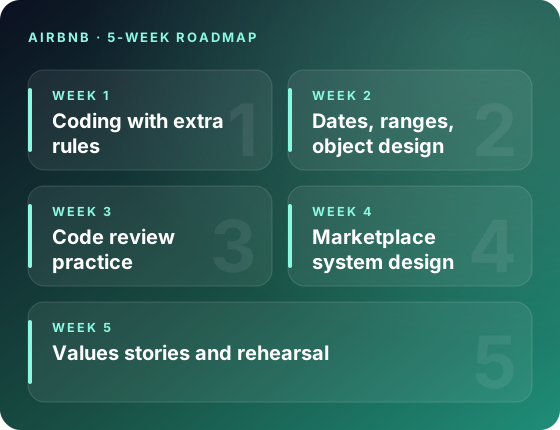
A 5-week order of preparation for the Airbnb loop. Stretch it or squeeze it to the time you have.
Week 1. Practical coding in Forge with extra requirements: take every solved problem and add one new rule to it.
Week 2. Dates, ranges and availability problems, then object design for a booking system.
Week 3. Code review practice: review ten real changes, write your comments in priority order and read them back.
Week 4. System design for a marketplace: booking without double-booking, search with filters, reviews. Two mocks in the Mock Arena.
Week 5. Core values and experience: write your stories, practise saying them aloud, and rehearse the full loop once.
The Interview plan tab in Revision builds a daily schedule from your weeks and hours, ticks off what you finish and brings your weak topics back through spaced revision. Airbnb's plan is part of Pro.
Practice prompts
These are our own, written for practice. They are not questions anyone reports being asked.
Book a listing for a date range and reject overlaps, then handle dates a host has blocked.
Review a change that adds a cache to a search service. Write your five most important comments in priority order.
Design a booking system where two guests try to reserve the same night at the same moment.
Design search for listings with filters, map bounds and flexible dates.
Design a review system where guests and hosts review each other without seeing the other's review first.
Describe a project you are proud of: what was hard, what did you change personally, and what would you do differently?
Tell me about a time you disagreed with a manager's decision and what happened next.
Describe a deadline where you were tempted to cut a corner. What did you do?
Questions to ask your recruiter
Which rounds will I have, and how long is each?
Will there be a code review round, and in which language?
Is there a system design screen before the loop at my level?
How should I prepare for the core values interviews?
Is there an experience deep dive for my level?
What we know and what we do not
Airbnb's FAQ and engineering blog confirm the shape of the process and the core values interviews, and nothing about the technical rounds. The rest is the shape accounts agree on, which varies by team and changes over time; the engineering post is older and undated, so confirm its details by reading it yourself. We have not included any question a candidate says they were asked, and nothing here is a promise about what you will see. If your recruiter tells you something different, believe your recruiter. Last reviewed in October 2026.