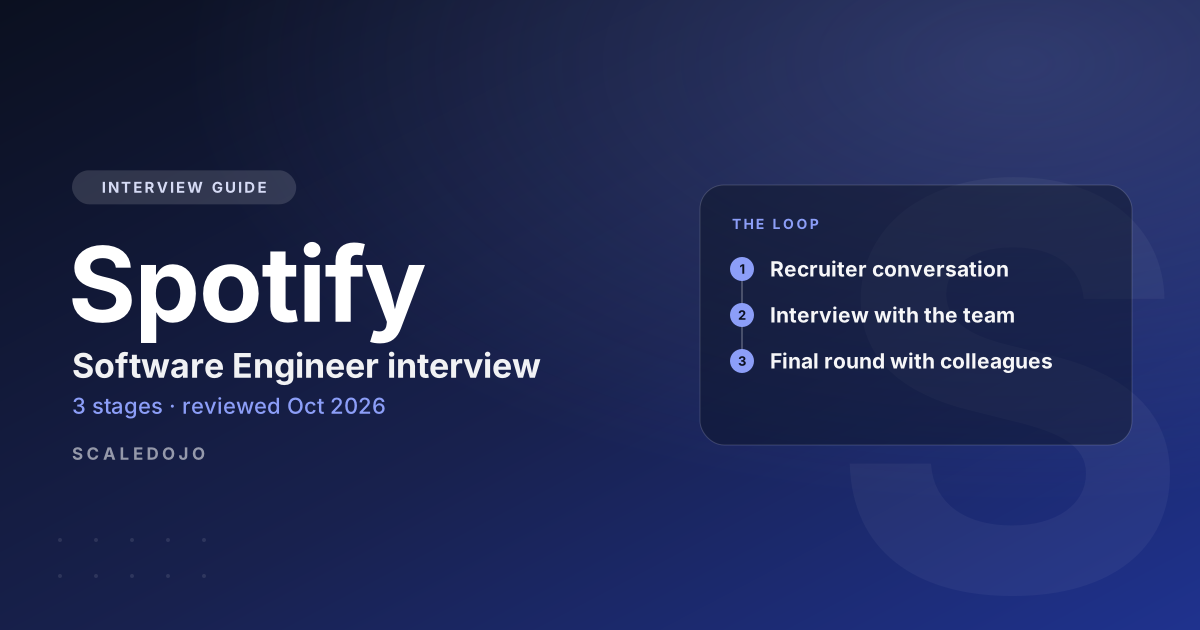
The Spotify software engineer interview is built around understanding the work you have done, your results and the thinking behind them. There are technical rounds too, with a coding exercise, a design discussion and, according to candidates, a debugging case study. This guide covers what Spotify says, what candidates describe, and how to prepare for each part.
How we put this together. Spotify's interview FAQ gives the three rounds, the tools it uses for remote interviews and the qualities it assesses. It does not give lengths or say what the technical rounds contain. That detail is the shape several public candidate accounts agree on, read in October 2026. Spotify has not confirmed it, and teams differ.
The loop at a glance
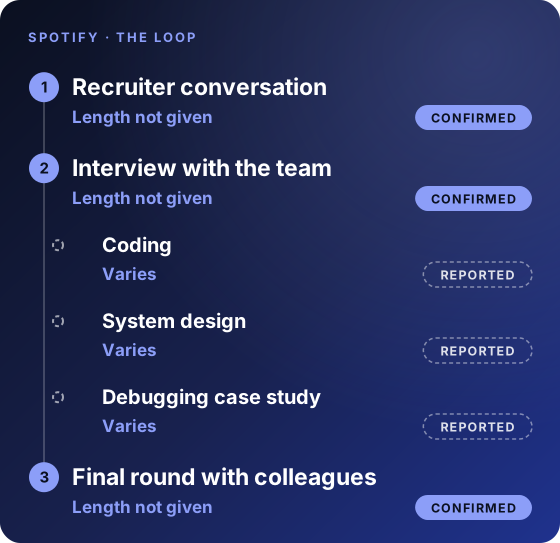
The Spotify loop. Solid markers are confirmed by Spotify. Dashed markers are reported by candidates. Confirm your own schedule with your recruiter.
Round | Typical length | What happens | How sure are we |
|---|---|---|---|
Recruiter conversation | Not given | A video or phone chat about you, the role and your background. | Spotify confirms it |
Interview with the team | Not given | One or two members of the team; technical parts use CoderPad and Mural. | Spotify confirms it |
Final round with colleagues | Not given | Meeting several colleagues across the business; one leads and others shadow. | Spotify confirms it |
Coding | Varies | Algorithmic and practical problems in a shared editor, plus some fundamentals. | Reported |
System design | Varies | A design discussion on a shared whiteboard. | Reported |
Debugging case study | Varies | A problem in a running system that you investigate by asking questions. | Reported |
Spotify says it tries to get back to candidates within a few days of the final interviews, and that it aims to give feedback where it can. Accounts describe two technical interviews and, for some candidates, a final loop of about four conversations.
What makes Spotify different
The interviewers are your potential teammates. Spotify's rounds are with the team and with colleagues across the business, so how you would work with them is part of what they judge.
Spotify names the qualities it assesses. Its FAQ lists values, ownership and pride in your work, adaptability, collaboration and drive. You can prepare for each directly.
Shadowing is normal. When more than one person interviews you, one leads and the others shadow. Do not let a quiet second person put you off.
A debugging case study is a different skill. Accounts describe a round where you ask questions to uncover a problem and then reason to a root cause, which tests how you investigate more than what you have memorised.
Round by round
Recruiter conversation
A chat about you, the role and your background. Spotify wants to understand the work you have done, the results and the thinking behind them. Have two projects ready with the goal, your part and the outcome, and ask which tools the technical rounds use.
Interview with the team
One or two team members. Spotify says it uses CoderPad for technical exercises and Mural for collaborative whiteboarding, so practise in both. Accounts describe an algorithmic and practical coding exercise of easy to medium difficulty, sometimes with questions on fundamentals such as networking, processes and threads.
Say what you plan to do before you type, and test with a small example.
Be ready for a short question on how the web or operating systems work.
Keep your code readable: names, small functions, one clear idea at a time.
Practise on ScaleDojo: Forge modules on Hashing, Heaps & Priority Queues, Sorting Algorithms, Trees & Binary Search Trees and Graph Fundamentals, with a time limit.
Final round with colleagues
You meet several people from across the business. Accounts describe system design, coding, a debugging case study and a behavioural conversation, though the mix depends on the team. Because interviewers shadow, expect questions that feel like a discussion rather than an exam.
System design
Accounts describe a design discussion on a shared whiteboard. Spotify's products suggest useful practice: playback and offline downloads, search, recommendations, podcasts and event pipelines. That is our suggestion, not a list of questions. State your requirements, draw the main path, then go deep on the part the interviewer chooses.
Practise on ScaleDojo: the HLD course, especially Caching for Speed, Storage at Scale, Asynchronous Systems, Observability & Operating at Scale and the Capstone Case Studies, then mocks in the Mock Arena.
Debugging case study
As candidates describe it, the interviewer states a problem seen in production and you ask questions to reveal information step by step, then reason to a root cause and suggest fixes. The skill is a method: form a hypothesis, ask for the one fact that would confirm or kill it, and say what you would measure.
Behavioural questions
Use Spotify's own list: values, ownership, adaptability, collaboration and drive. Prepare one honest story for each, and include what it cost you and what you learned.
How the loop differs by level
Spotify's FAQ does not split the process by level, and the public accounts do not agree. Our reading, not a Spotify statement: earlier-career candidates should expect more coding, and experienced candidates a larger share of design and discussion about ownership and influence. Ask your recruiter how your level is weighted.
A five-week preparation plan
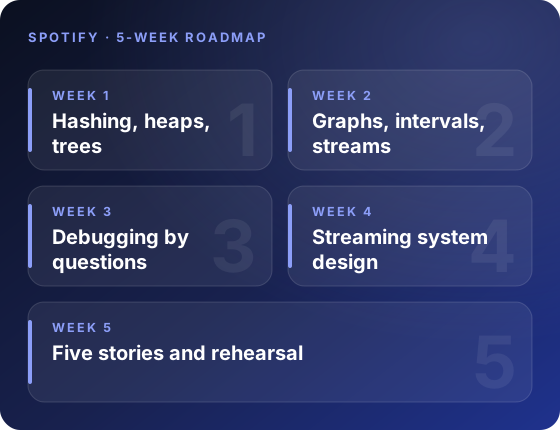
A 5-week order of preparation for the Spotify loop. Stretch it or squeeze it to the time you have.
Week 1. Hashing, heaps, sorting and trees in Forge, timed. Practise in a shared editor.
Week 2. Graphs, intervals and streams of events, then a few fundamentals questions on networking and processes.
Week 3. Debugging practice: take a failing service description and find the root cause with questions only.
Week 4. System design on streaming, search and recommendations, with two mocks on a shared whiteboard.
Week 5. Five stories, one for each quality Spotify names, then a full rehearsal.
The Interview plan tab in Revision builds a daily schedule from your weeks and hours, ticks off what you finish and brings your weak topics back through spaced revision. Spotify's plan is part of Pro.
Practice prompts
These are our own, written for practice. They are not questions anyone reports being asked.
Return the k most played tracks in the last hour from a stream of play events.
Find the shortest chain of collaborations that connects two artists.
Design music playback with offline downloads that stay valid for a limited time.
Design a weekly personalised playlist for every listener.
Playlists load slowly for some users only. List the questions you would ask, in order, to find the cause.
Describe something you owned that you are proud of, and what you would still improve.
Questions to ask your recruiter
Which rounds will I have, and how long is each?
Which tools do the technical interviews use, and may I use my own editor?
Is there a system design round or a debugging case study at my level?
Who will interview me in the final round?
How should I prepare for the questions about ownership and collaboration?
What we know and what we do not
Spotify's FAQ confirms the three rounds, the tools and the qualities it assesses, and gives no lengths or counts. The technical detail is the shape accounts agree on, which differs by team and changes over time. We have not included any question a candidate says they were asked, and nothing here is a promise about what you will see. If your recruiter tells you something different, believe your recruiter. Last reviewed in October 2026.