Adobe builds tools that people use for hours at a time: editors, document software, shared creative workspaces. That shapes what its interviewers care about. Alongside the usual coding and design rounds, expect questions about quality, collaboration and how a feature feels to use. This guide walks through the Adobe software engineer interview loop, what each part is judging, and how to prepare.
How we put this together. Adobe's own hiring page names the stages: a Talent Partner conversation, a hiring manager interview, then skills assessments and team interviews. For technical roles it names coding challenges, system design discussions or portfolio reviews. It gives no lengths or counts. The round-level detail below is the shape several public candidate accounts agree on, read in October 2026. Adobe has not confirmed it, and accounts stress that every team runs its own format.
The loop at a glance
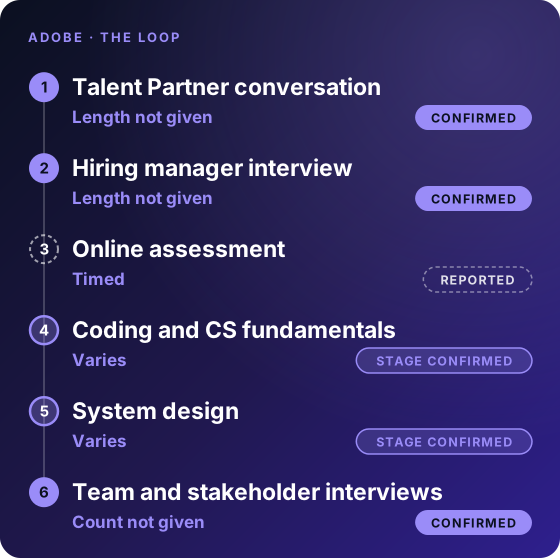
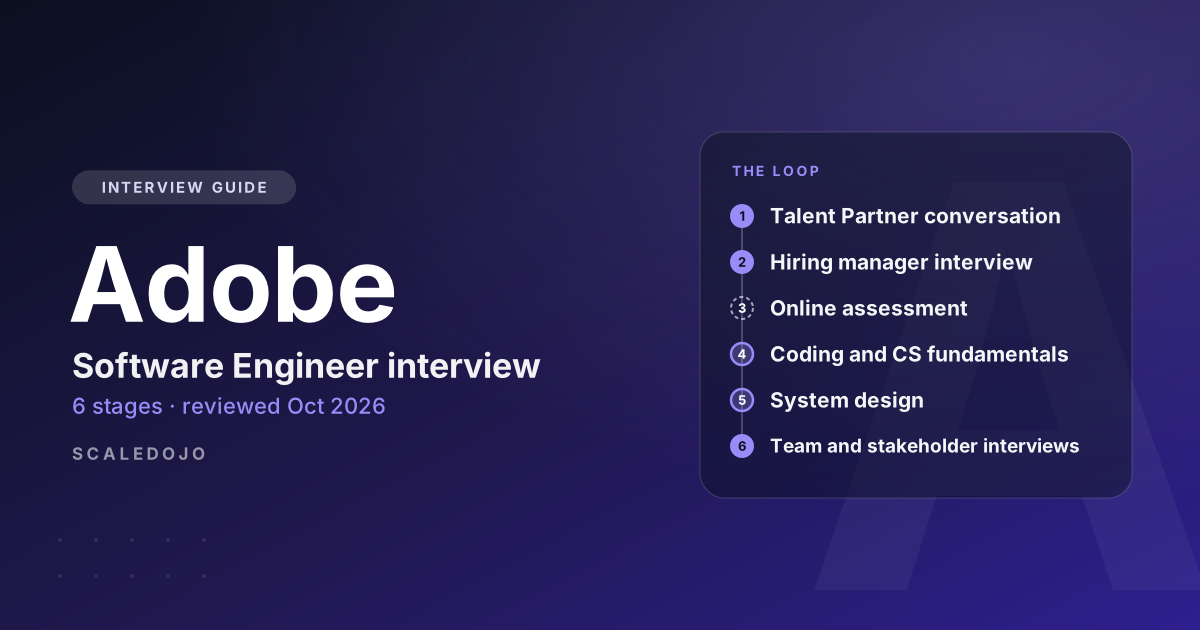
The Adobe loop. Solid markers are confirmed by Adobe. Tinted markers are stages Adobe names, with the detail from candidates. Dashed markers are reported by candidates. Confirm your own schedule with your recruiter.
Stage | Typical length | What happens | How sure are we |
|---|---|---|---|
Talent Partner conversation | Varies | An in-depth conversation about your background, your career goals and the team. | Adobe confirms it; no length given |
Hiring manager interview | Varies | Your background and problem-solving, with the hiring manager asking about measurable impact. | Adobe confirms it; no length given |
Online assessment | Timed | Some candidates start with a timed coding assessment. | Reported; not every team |
Coding and CS fundamentals | Varies | Data structures, strings, arrays and recursion, plus computer-science basics. | Adobe names coding challenges; the detail is reported |
System design | Varies | A design discussion, often framed around creative or document products. | Adobe names system design discussions; the framing is reported |
Team and stakeholder interviews | Varies | Interviews with potential teammates and partners. | Adobe confirms them; the count is not given |
Accounts put the whole process at four to five rounds, but the number and order depend on the team. Adobe's page also says AI and recording tools are not permitted in live interviews unless the interviewer invites them or an accommodation is approved, so ask before you rely on either.
What makes Adobe different
Every team writes its own interview. Some ask classic algorithm problems; others give practical, project-style tasks. Ask your recruiter which kind to expect.
Measurable impact is asked for by name. Adobe's page tells every candidate to bring specific examples that show impact from previous work, so have numbers ready.
Design problems lean toward creative and document products. Accounts mention real-time collaboration, conflict resolution, offline sync and large files. Those are our suggestion of what to practise, not a list of questions.
Collaboration is part of the signal. You meet potential teammates and stakeholders, so how you explain and listen is judged alongside your code.
Round by round
Talent Partner conversation
A conversation, not a quiz. Adobe describes it as in-depth: your background, where you want to go, and the team's dynamics. Prepare a short story of what you have built, what you want more of, and why this team. Ask what the technical rounds look like for the role.
Hiring manager interview
The hiring manager explores your problem-solving and how your experience fits the role. Adobe's advice is to prepare specific examples with measurable impact. Choose two or three projects and be able to say the goal, your part, the result in numbers, and what you would change.
Coding rounds
Accounts describe questions on arrays, strings, recursion and common data structures, with follow-ups on complexity and edge cases. Some teams use a timed online assessment first. Because teams differ, prepare both styles: classic problems under a clock, and a small practical task where you structure the code cleanly.
Say your approach before you code, then walk an example through by hand.
State time and space complexity without being asked.
Test with an empty input, a single item and a repeated value.
Practise on ScaleDojo: Forge modules on Array & String Techniques, Hashing, Linked Lists, Recursion & Memoization, Trees & Binary Search Trees and Sorting Algorithms.
System design
Adobe names system design discussions for technical roles. Expect a standard structure, requirements, a first design, then deep dives, with a lean toward products where many people edit the same thing. Practise explaining how two edits to one document are reconciled, how large files are stored and previewed, and how a client keeps working when the network drops.
Practise on ScaleDojo: the HLD course, especially Real-Time Systems, Storage at Scale, Caching for Speed and the Capstone Case Studies, then a time-boxed mock in the Mock Arena.
Team and stakeholder interviews
You meet potential teammates and partners, who judge how you would work with them. Expect questions on how you handle feedback, disagree with a designer or product manager, and explain a technical trade-off to someone who is not an engineer. Bring one story for each.
Practise on ScaleDojo: the LLD course, especially SOLID Principles, Structural Patterns and Behavioral Patterns, because editor-style software leans heavily on commands, undo and plug-ins.
How the loop differs by level
Adobe's page does not split the process by level, and the public accounts do not agree. Our reading, not an Adobe statement: early-career loops lean on coding fundamentals, while senior loops add more design and more discussion of impact and influence. Ask your recruiter how your level is weighted.
A five-week preparation plan
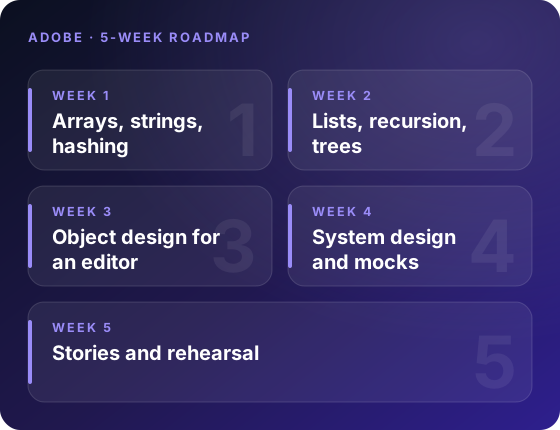
A 5-week order of preparation for the Adobe loop. Stretch it or squeeze it to the time you have.
Week 1. Arrays, strings and hashing in Forge. Practise saying your approach aloud.
Week 2. Linked lists, recursion, trees and sorting. Add one timed set of three problems.
Week 3. Object design for an editor: shapes, commands, undo and plug-ins in the LLD course.
Week 4. System design: co-editing, version history, large-file storage and previews, with two mocks.
Week 5. Stories with numbers, questions for the team, and one full rehearsal.
The Interview plan tab in Revision builds a daily schedule from your weeks and hours, ticks off what you finish and brings your weak topics back through spaced revision. Adobe's plan is part of Pro.
Practice prompts
These are our own, written for practice. They are not questions anyone reports being asked.
Composite a stack of layers with opacity and visibility flags into one result, from bottom to top.
Implement undo and redo with a bounded history, and say what happens to redo after a new edit.
Design real-time co-editing so two people can type in the same paragraph without losing text.
Design version history for a file so any earlier version can be opened and restored.
Design thumbnails and previews for millions of uploaded images and videos.
Tell me about a project where you can name the measurable result and how you measured it.
Questions to ask your recruiter
Which rounds will I have, and how long is each?
Is there an online assessment first, and which languages does it support?
Is the coding classic algorithms, practical tasks, or both?
How is system design weighted for my level?
Which tools, if any, may I use during live interviews?
What we know and what we do not
Adobe's page confirms the stages and the kinds of assessment for technical roles, and nothing about lengths or counts. The rest is the shape accounts agree on, which differs by team and changes over time. We have not included any question a candidate says they were asked, and nothing here is a promise about what you will see. If your recruiter tells you something different, believe your recruiter. Last reviewed in October 2026.